 Living Beings
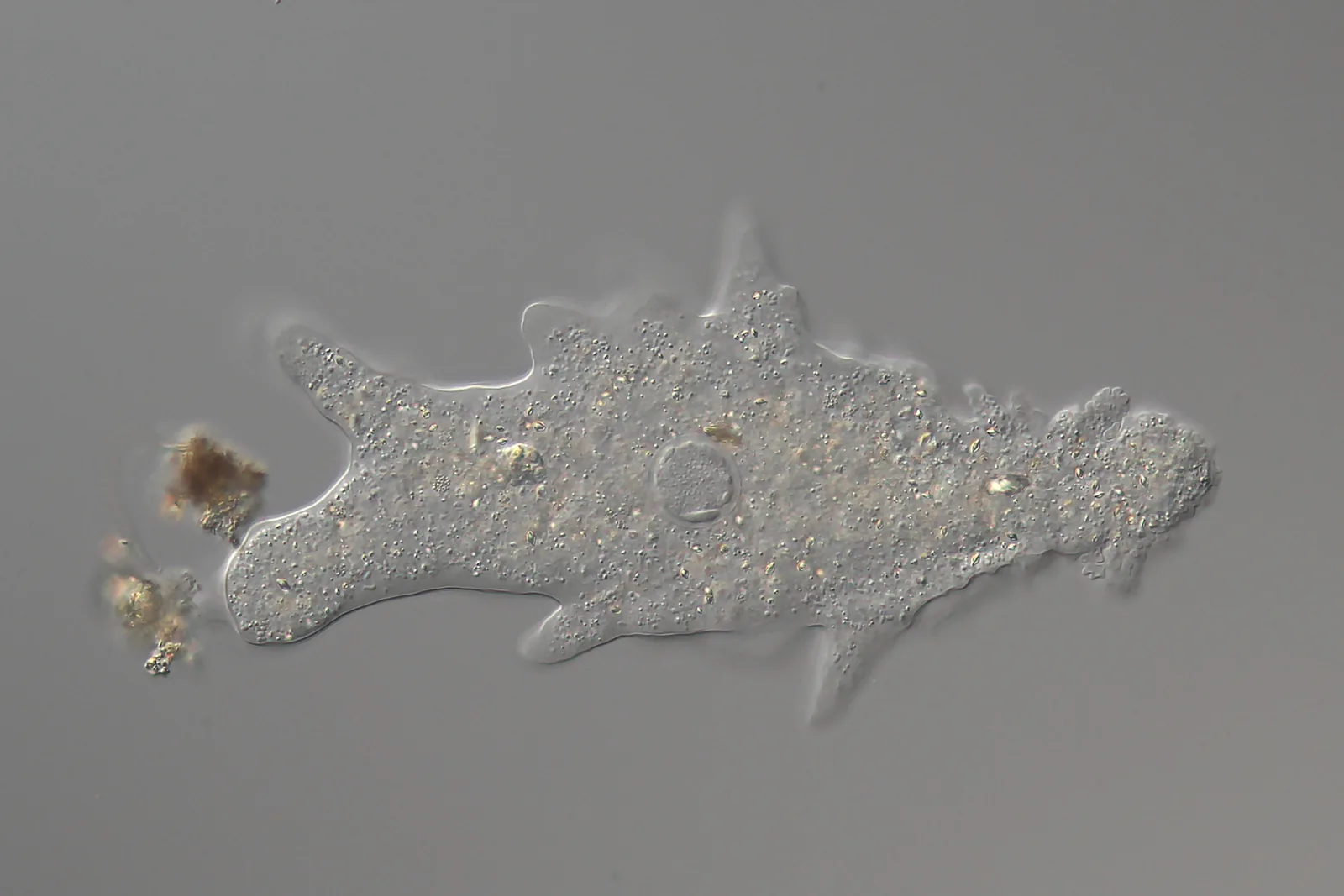
Amoeba proteus another form.jpg · Resized and converted to WebP for display. Source-identified documentary image; see the original file for method and context. AI-generated illustration. SmallRex · CC BY-SA 4.0

Field guide · species
Amoeba proteus
Amoeba proteus is a large single-celled eukaryote that changes shape as it moves and feeds. Temporary extensions called pseudopodia connect visible cell shape with the movement of cytoplasm inside the cell.
Public research profile · final editorial review pending.
Tree of lifeScientific lineage
- LifeLife
- DomainEukaryota
- PhylumTubulinea
- ClassElardia
- OrderEuamoebida
- FamilyAmoebidae
- GenusAmoeba
- SpeciesAmoeba proteus
Advanced classification
Complete source lineage, including intermediate ranks. The standard view uses Life and the eight principal ranks.
- cellular organisms cellular root
- Eukaryota domain
- Amoebozoa clade
- Tubulinea phylum
- Elardia class
- Euamoebida order
- Amoebidae family
- Amoeba genus
- Amoeba proteus species
Structure and identification
An irregular outline and flowing extensions distinguish a moving cell. A nucleus and vacuoles can be observed using suitable microscopy.
Habitat and range
Freshwater environments with microbial food and suitable surfaces support its crawling and feeding activity.
Nutrition and metabolism
Pseudopodia surround food particles and small organisms, bringing them into vacuoles for digestion.
Biological activity
The cell forms pseudopods as its shape changes. Direct pressure measurements found that internal pressure rose before movement and decreased around pseudopod formation, supporting a role for hydrostatic pressure driven by the contractile cell cortex. This links movement with the mechanics of a living cell rather than an animal-like limb.
Reproduction and life cycle
A growing cell can divide after nuclear replication. This profile does not assign a complex reproductive stage from another amoeba species.
Geographic distribution
Recorded cultures have particular collection histories. Identifying every large freshwater amoeba as A. proteus would overstate its distribution.
Ecological role
Consumption of microorganisms connects it with freshwater microbial food webs.
Distinctive adaptations
A deformable cell surface supports both movement and feeding. Contractile-vacuole activity helps manage water balance in freshwater.
Evidence
Sources
- Amoeba proteus · NCBI Taxonomy ↗NCBI
- Intracellular pressure is a motive force for cell motion in Amoeba proteus ↗Cell motility and the cytoskeleton · 1996
Connected life
Relationships
No reviewed ecological connections in the collection yet.
Explore network ↗