 Living Beings
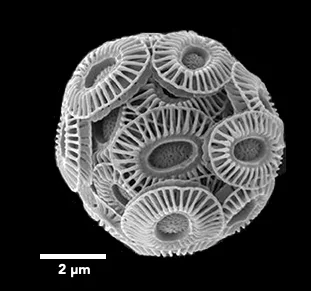
Emiliania huxleyi.jpg · Resized and converted to WebP for display. Identification awaits editorial review. AI-generated illustration. Dr. Jeremy Young, University College London · CC BY-SA 4.0

Field guide · species
Emiliania huxleyi
(Lohmann) W.W.Hay & H.P.Mohler
Emiliania huxleyi is a marine coccolithophore associated with striking blooms and calcified cell coverings. The name follows the project's dated NCBI backbone; other classifications use Gephyrocapsa huxleyi for this lineage.
Public research profile · final editorial review pending.
Tree of lifeScientific lineage
- LifeLife
- DomainEukaryota
- PhylumHaptophyta
- OrderIsochrysidales
- FamilyNoelaerhabdaceae
- GenusEmiliania
- SpeciesEmiliania huxleyi
Advanced classification
Complete source lineage, including intermediate ranks. The standard view uses Life and the eight principal ranks.
- cellular organisms cellular root
- Eukaryota domain
- Haptista clade
- Haptophyta phylum
- Prymnesiophyceae clade
- Isochrysidales order
- Noelaerhabdaceae family
- Emiliania genus
- Emiliania huxleyi species
Structure and identification
Calcifying cells carry intricately shaped calcium-carbonate plates called coccoliths. Electron microscopy reveals their detailed architecture.
Habitat and range
Illuminated marine waters support photosynthetic growth. Different strains have contrasting ecological capabilities.
Nutrition and metabolism
Photosynthesis fixes inorganic carbon. Calcification is a separate process and should not be equated with a simple net removal of atmospheric carbon dioxide.
Biological activity
Population blooms occur under suitable conditions. Different genomes and metabolic repertoires contribute to environmental responses.
Reproduction and life cycle
The life cycle includes a diploid phase, commonly bearing calcium-carbonate coccoliths, and a non-calcified haploid phase with two flagella. Diploid cells can also be non-calcified. A field mesocosm study detected both calcified and non-calcified cells during bloom succession, so lack of a visible coccolith covering does not by itself exclude this organism.
Geographic distribution
The cited genomic study describes extensive strain variation associated with habitats from equatorial to subarctic waters.
Ecological role
Organic-carbon production, calcification and export to deeper water give the group a complex role in the marine carbon cycle.
Distinctive adaptations
Coccolith formation and substantial between-strain genomic variation are distinctive features.
Evidence
Sources
Connected life
Relationships
No reviewed ecological connections in the collection yet.
Explore network ↗