Living Beings
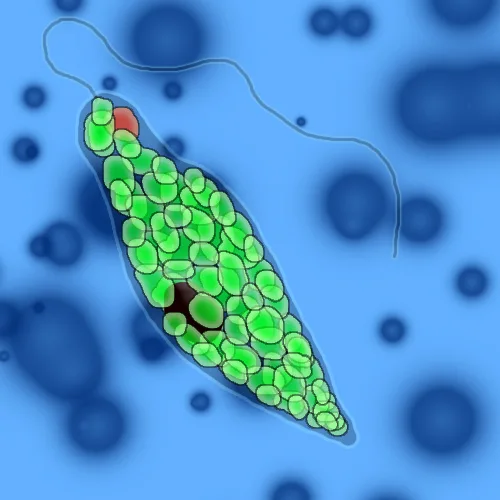
Euglena gracilis.jpg · Resized and converted to WebP for display. Source-identified documentary image; see the original file for method and context. AI-generated illustration. naturalismus · CC BY-SA 2.0

Field guide · species
Euglena gracilis
Klebs, 1883
Euglena gracilis combines green chloroplasts with active movement and flexible nutrition. It is a single-celled eukaryote, and its biology does not fit a simple division in which every mobile organism is an animal and every green organism is a plant.
Public research profile · final editorial review pending.
Tree of lifeScientific lineage
- LifeLife
- DomainEukaryota
- PhylumEuglenozoa
- ClassEuglenophyceae
- OrderEuglenales
- FamilyEuglenaceae
- GenusEuglena
- SpeciesEuglena gracilis
Advanced classification
Complete source lineage, including intermediate ranks. The standard view uses Life and the eight principal ranks.
- cellular organisms cellular root
- Eukaryota domain
- Discoba clade
- Euglenozoa phylum
- Euglenida clade
- Spirocuta clade
- Euglenophyceae class
- Euglenales order
- Euglenaceae family
- Euglena genus
- Euglena gracilis species
Structure and identification
Elongated cells have a flexible covering, chloroplasts and a flagellum used in movement. The outline can change during characteristic euglenoid motion.
Habitat and range
Freshwater and resource-rich aquatic conditions support studied populations and cultures.
Nutrition and metabolism
Photosynthesis supplies carbon under suitable light, while organic substrates can support heterotrophic growth under other conditions.
Biological activity
Light-responsive movement and changes in body form connect environmental sensing with locomotion.
Reproduction and life cycle
Cells reproduce through division. Growth form and physiology change with culture conditions without representing separate species.
Geographic distribution
Cultures are studied internationally. Field records require species identification rather than recognition of a generic green flagellate.
Ecological role
Its flexible resource use connects photosynthetic production with consumption of organic compounds.
Distinctive adaptations
Its plastids descend from a green alga acquired through secondary endosymbiosis. A mixotrophic lifestyle and metabolic flexibility permit growth under varied conditions. Those features make it an informative example of eukaryotic evolution: photosynthesis does not require that a single-celled organism be placed among land plants.
Evidence
Sources
- Euglena gracilis · NCBI Taxonomy ↗NCBI
- Microbe Profile: Euglena gracilis: photogenic, flexible and hardy ↗Microbiology (Reading, England) · 2022
Connected life
Relationships
No reviewed ecological connections in the collection yet.
Explore network ↗