 Living Beings
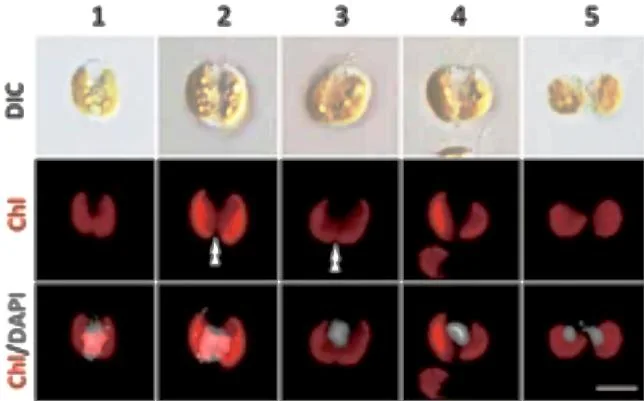
41598 2017 2668 Fig2d HTML.jpg · Resized and converted to WebP for display. Microscopy montage: transmitted light, chloroplast fluorescence and DNA staining; experimental colors. AI-generated illustration. Ryo Onuma, Neha Mishra, Shin-ya Miyagishima (contrast enhanced extract) · CC BY-SA 4.0

Field guide · species
Guillardia theta
D.R.A.Hill & R.Wetherbee, 1990
Guillardia theta is a unicellular cryptophyte alga with an unusually informative evolutionary history. Its plastid descends from a red alga incorporated into another eukaryotic cell.
Public research profile · final editorial review pending.
Tree of lifeScientific lineage
- LifeLife
- DomainEukaryota
- ClassCryptophyceae
- OrderPyrenomonadales
- FamilyGeminigeraceae
- GenusGuillardia
- SpeciesGuillardia theta
Advanced classification
Complete source lineage, including intermediate ranks. The standard view uses Life and the eight principal ranks.
- cellular organisms cellular root
- Eukaryota domain
- Cryptophyceae class
- Pyrenomonadales order
- Geminigeraceae family
- Guillardia genus
- Guillardia theta species
Structure and identification
The microscopy montage combines transmitted-light images with fluorescence channels. The colored signals mark cellular structures and should not be mistaken for the organism’s natural visible coloration.
Scientific source 1 ↗ · Scientific source 2 ↗ · Scientific source 3 ↗
Habitat and range
The cited sequencing studies describe laboratory strains. A complete field distribution and habitat preference should not be inferred from those cultures alone.
Scientific source 1 ↗ · Scientific source 2 ↗ · Scientific source 3 ↗
Nutrition and metabolism
A chloroplast supports photosynthesis. The plastid contains its own compact genome, distinct from the main nuclear genome.
Scientific source 1 ↗ · Scientific source 2 ↗ · Scientific source 3 ↗
Biological activity
Cellular research distinguishes nuclear, plastid and mitochondrial functions rather than assigning all activity to a single genome.
Scientific source 1 ↗ · Scientific source 2 ↗ · Scientific source 3 ↗
Reproduction and life cycle
Cells grow and divide as microscopic eukaryotes. The image follows cellular stages; these are not separate species or animal life stages.
Scientific source 1 ↗ · Scientific source 2 ↗ · Scientific source 3 ↗
Ecological role
As an alga it contributes a photosynthetic lineage to microbial diversity. The cited genome studies do not provide a full account of its abundance in nature.
Scientific source 1 ↗ · Scientific source 2 ↗ · Scientific source 3 ↗
Distinctive adaptations
A nucleomorph, a highly reduced remnant nucleus of the engulfed red-algal partner, persists beside the plastid. This is evidence of secondary endosymbiosis.
Scientific source 1 ↗ · Scientific source 2 ↗ · Scientific source 3 ↗
Evidence
Sources
- Guillardia theta · NCBI Taxonomy ↗www.ncbi.nlm.nih.gov
- Guillardia theta · Biological reference ↗pubmed.ncbi.nlm.nih.gov
- Guillardia theta · Biological reference ↗pubmed.ncbi.nlm.nih.gov
- Guillardia theta · Biological reference ↗pubmed.ncbi.nlm.nih.gov
Connected life
Relationships
No reviewed ecological connections in the collection yet.
Explore network ↗