 Living Beings
 Framed for display
Compare species
Cheetah
Acinonyx jubatus
Asian Golden Cat
Catopuma temminckii
Try a comparison
How to compare two organisms
Choose two species and trace their closest shared group. Then compare a trait with the same definition on each side. Check the units, life stage and context before interpreting a measurement or range.
Missing data means that the collection lacks a sourced value. Where a characteristic does not apply to a lineage, the comparison labels it separately. Open the two profiles for context and follow their sources before drawing a conclusion.
Biological comparison
Means, ranges and reported maxima describe different things. Check the source and population before comparing values.
Classification
Shared ancestry
Closest shared evolutionary group · Felinae.
Separate lineages
Asian Golden CatgenusCatopumaspeciesCatopuma temminckii
| Characteristic | Cheetah | Asian Golden Cat |
|---|---|---|
Scientific measurements | Scientific measurements | |
| Body mass |
38.0 kg
Mean · Adult Source and measurement contextLiterature value used in a comparative paper. The authors separate these mass references from their zoo sample. · ≈ 83.8 lb Mass of an individual animal.
| No measurement recorded |
| Head and body length | No measurement recorded |
0.71–1.05 m
Reported range Source and measurement contextThe group distinguishes body length from its separate tail length range. · ≈ 2.3–3.44 ft Head and body, excluding the tail.
|
Natural history | Natural history | |
| Nutrition and energy acquisition |
Gazelles and other small to medium-sized mammals are important prey. Actual prey varies with location and opportunity. Source 1 ↗Source 2 ↗ |
Small mammals and other vertebrates form its carnivorous diet. It can take a range of prey sizes. Source 1 ↗Source 2 ↗ |
| Habitat |
Grassland, dry open country and other habitats with space for pursuit are used. Source 1 ↗Source 2 ↗ |
Different forest types are used, including evergreen and deciduous woodland. Source 1 ↗Source 2 ↗ |
| Geographic distribution |
The Mammal Diversity Database v2.5 records this species in Algeria, Angola, Benin, Botswana, Burkina Faso, Central African Republic, Chad, Eswatini, …The Mammal Diversity Database v2.5 records this species in Algeria, Angola, Benin, Botswana, Burkina Faso, Central African Republic, Chad, Eswatini, Ethiopia, Iran, Kenya, Mali, Mozambique, Namibia, Niger, South Africa, South Sudan, Tanzania, Uganda, Zambia, Zimbabwe, Djibouti?, Egypt?, Eritrea?, Libya?, Somalia?, Sudan?, Togo?. |
The Mammal Diversity Database v2.5 records this species in Bangladesh, Bhutan, Cambodia, China, India, Indonesia, Laos, Malaysia, Myanmar, Nepal, Thailand, Vietnam. Source 1 ↗Source 2 ↗ |
| Morphology |
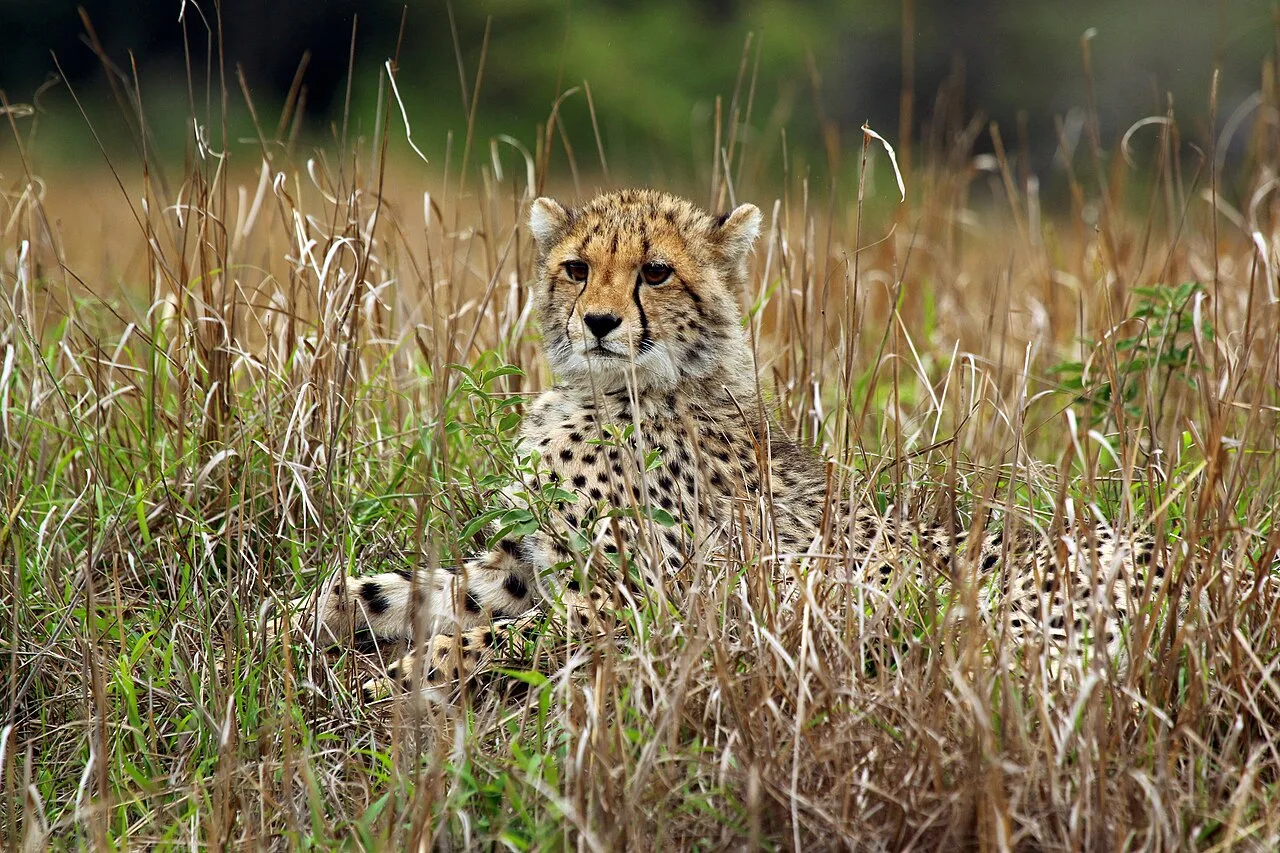
A small rounded head, spotted coat and long legs produce a slender outline. Dark facial lines extend below the eyes. Source 1 ↗Source 2 ↗ |
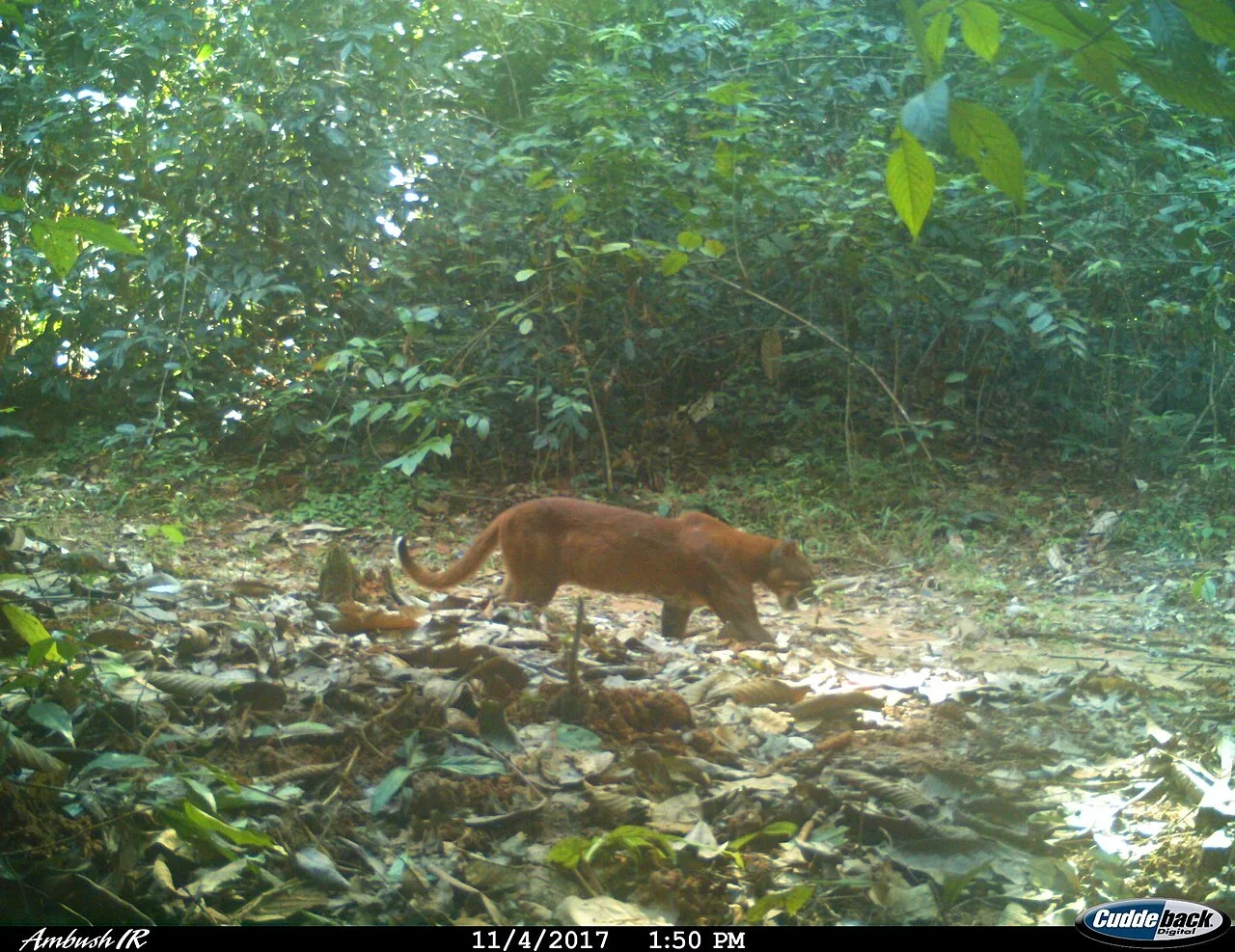
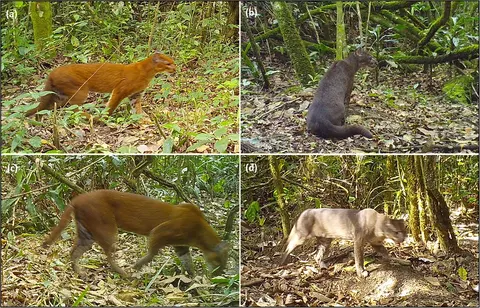
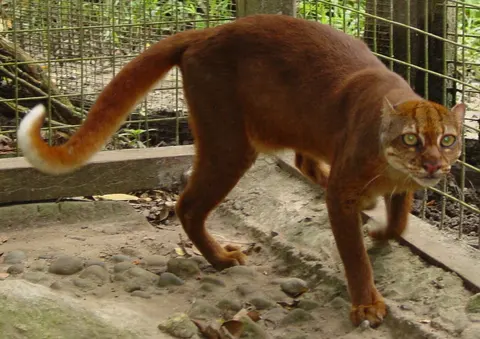
Coat colors vary, and facial markings can be useful distinguishing features. A golden coat is only one form of this …Coat colors vary, and facial markings can be useful distinguishing features. A golden coat is only one form of this cat. Some individuals are gray or dark, and a spotted form with rosettes has been recorded in Bhutan and parts of China. Look at the light facial lines bordered by dark fur as well as coat color when interpreting a camera-trap photograph. |
| Ecological role |
No separate account recorded |
Camera traps have recorded Asian golden cats during daylight and at other times of day. Radio tracking of two individuals …Camera traps have recorded Asian golden cats during daylight and at other times of day. Radio tracking of two individuals in Thailand's Phu Khiao Wildlife Sanctuary found a similar pattern. Local observations help describe when the cats move through a forest, though activity across the whole range remains less well known. |
| Behavior and activity |
Social organization differs between individuals: some males associate in coalitions, while females raising young face different demands. Source 1 ↗Source 2 ↗ |
Tracking studies demonstrate that assumptions based only on occasional night sightings can be misleading. Activity varies rather than fitting a simple universal nocturnal label. Source 1 ↗Source 2 ↗ |
| Environmental adaptations |
Researchers fitted free-ranging cheetahs in Botswana with movement recorders and measured whole hunting runs. Many chases stayed below the highest …Researchers fitted free-ranging cheetahs in Botswana with movement recorders and measured whole hunting runs. Many chases stayed below the highest speed the animals reached. The recorders showed rapid acceleration, braking and sideways changes in direction, all of which matter when prey turns. A cheetah’s ability to match an evasive animal is therefore better understood from the entire chase than from its top speed alone. |
No separate account recorded |
Sources from both profiles
Cheetah
More comparisons
Framed for display

 Framed for display

 Framed for display
