 Living Beings

Field guide · species
Ignicoccus hospitalis
Paper et al. 2007
Ignicoccus hospitalis is a heat-loving archaeon with an unusual cell envelope. It is especially well known as a host for the much smaller archaeon Nanoarchaeum equitans.
Public research profile · final editorial review pending.
Tree of lifeScientific lineage
- LifeLife
- DomainArchaea
- KingdomThermoproteati
- PhylumThermoproteota
- ClassThermoprotei
- OrderDesulfurococcales
- FamilyDesulfurococcaceae
- GenusIgnicoccus
- SpeciesIgnicoccus hospitalis
Advanced classification
Complete source lineage, including intermediate ranks. The standard view uses Life and the eight principal ranks.
- cellular organisms cellular root
- Archaea domain
- Thermoproteati kingdom
- Thermoproteota phylum
- Thermoprotei class
- Desulfurococcales order
- Desulfurococcaceae family
- Ignicoccus genus
- Ignicoccus hospitalis species
Structure and identification
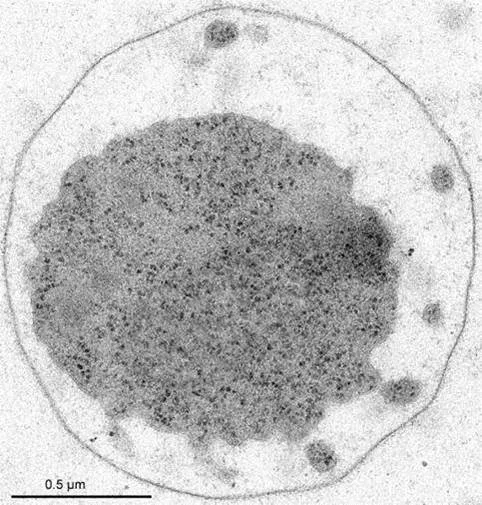
Electron microscopy reveals an inner membrane, an outer membrane and a substantial space between them. The image is a section through a cell, not a surface portrait.
Habitat and range
The cultured organism originates from a hot marine hydrothermal environment and grows under oxygen-free conditions.
Nutrition and metabolism
It can use hydrogen and sulfur in an energy metabolism coupled to carbon fixation. It does not need sunlight to build organic material.
Biological activity
Nanoarchaeum cells can attach to the host surface. The host can be grown independently, whereas the attached partner has severe metabolic limitations.
Reproduction and life cycle
Cell growth and division maintain the host population. Association with the partner changes the biological context, but the two organisms remain distinct species.
Ecological role
The association is a model for studying dependence between archaeal species. A single friendly label such as mutualism can conceal unresolved biological costs and exchanges.
Distinctive adaptations
Its membrane organization is exceptional among well-studied archaea and has been investigated using detailed electron-microscopy methods.
Evidence
Sources
- Ignicoccus hospitalis · NCBI Taxonomy ↗www.ncbi.nlm.nih.gov
- Ignicoccus hospitalis · Biological reference ↗pmc.ncbi.nlm.nih.gov
- Ignicoccus hospitalis · Biological reference ↗pmc.ncbi.nlm.nih.gov
Connected life
Relationships
No reviewed ecological connections in the collection yet.
Explore network ↗