 Living Beings
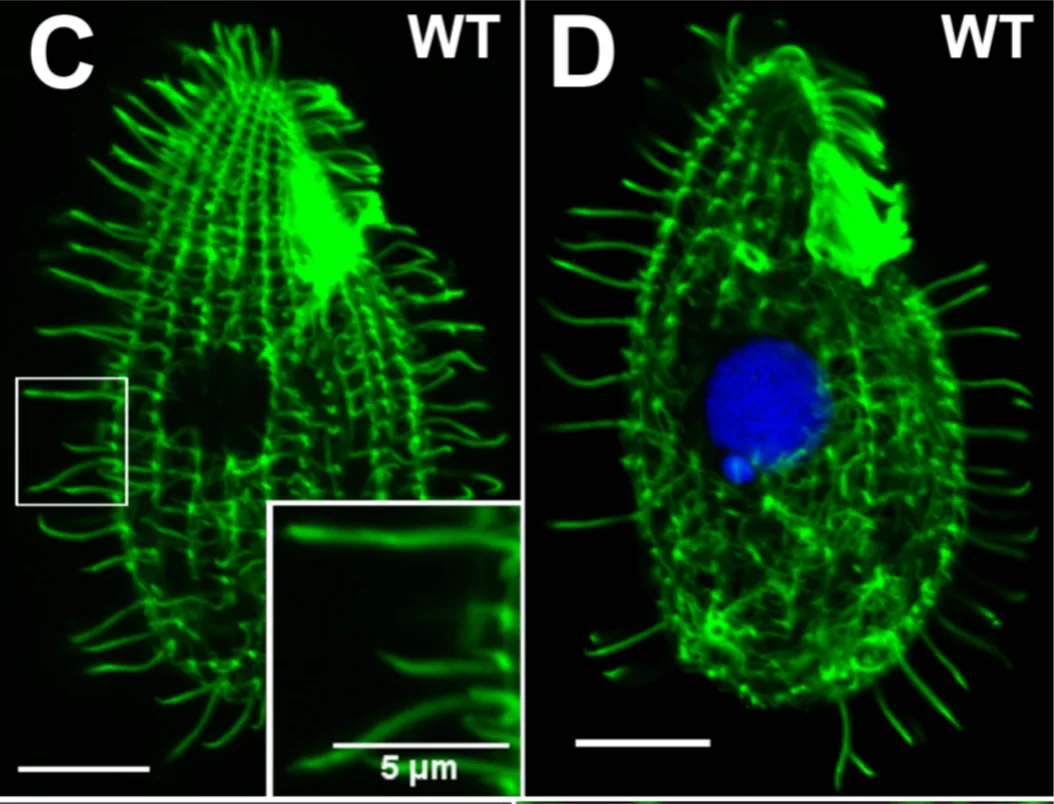
Tetrahymena Núcleos.png · Resized and converted to WebP for display. Fluorescence microscopy; labeling colors are not natural body colors. AI-generated illustration. Seixas C, Cruto T, Tavares A, Gaertig J, Soares H · CC BY 4.0

Field guide · species
Tetrahymena thermophila
Nanney & McCoy, 1976
Tetrahymena thermophila is a free-living ciliate whose single cell supports movement, feeding and two distinct nuclear roles. Its tractable genetics makes it a major model for cilia, chromosomes and the organization of eukaryotic cells.
Public research profile · final editorial review pending.
Tree of lifeScientific lineage
- LifeLife
- DomainEukaryota
- PhylumCiliophora
- ClassOligohymenophorea
- OrderHymenostomatida
- FamilyTetrahymenidae
- GenusTetrahymena
- SpeciesTetrahymena thermophila
Advanced classification
Complete source lineage, including intermediate ranks. The standard view uses Life and the eight principal ranks.
- cellular organisms cellular root
- Eukaryota domain
- Sar clade
- Alveolata clade
- Ciliophora phylum
- Intramacronucleata subphylum
- Oligohymenophorea class
- Hymenostomatida order
- Tetrahymenina suborder
- Tetrahymenidae family
- Tetrahymena genus
- Tetrahymena thermophila species
Structure and identification
A ciliated cell contains two functionally different nuclei. The micronucleus carries the germline genetic material used in sexual reproduction; the macronucleus is the principal center of everyday gene expression. Both occur within one cell, illustrating a division of genetic roles without the organism being multicellular.
Habitat and range
Freshwater-associated environments and laboratory cultures provide conditions for a predatory single-celled lifestyle.
Nutrition and metabolism
Cells acquire nutrients through feeding processes and transport systems, using microbial and dissolved resources according to conditions.
Biological activity
Cilia contribute to locomotion and feeding. Cellular signaling links behavior to environmental conditions.
Reproduction and life cycle
Vegetative division maintains cells. During sexual processes, the micronucleus transmits germline information and new somatic nuclear organization is established.
Geographic distribution
Research strains document particular lineages. A broad freshwater-ciliate range should not be substituted for verified species records.
Ecological role
The organism consumes resources within microbial communities and can itself be consumed by other organisms.
Distinctive adaptations
Division of labor between germline and somatic nuclei supports a complex cellular organization without a multicellular body.
Evidence
Sources
- Tetrahymena thermophila · NCBI Taxonomy ↗NCBI
- Tetrahymena as a model organism for cilia research ↗Seminars in cell & developmental biology · 2026
- Macronuclear genome sequence of the ciliate Tetrahymena thermophila, a model eukaryote ↗PLoS biology · 2006
Connected life
Relationships
No reviewed ecological connections in the collection yet.
Explore network ↗