 Living Beings
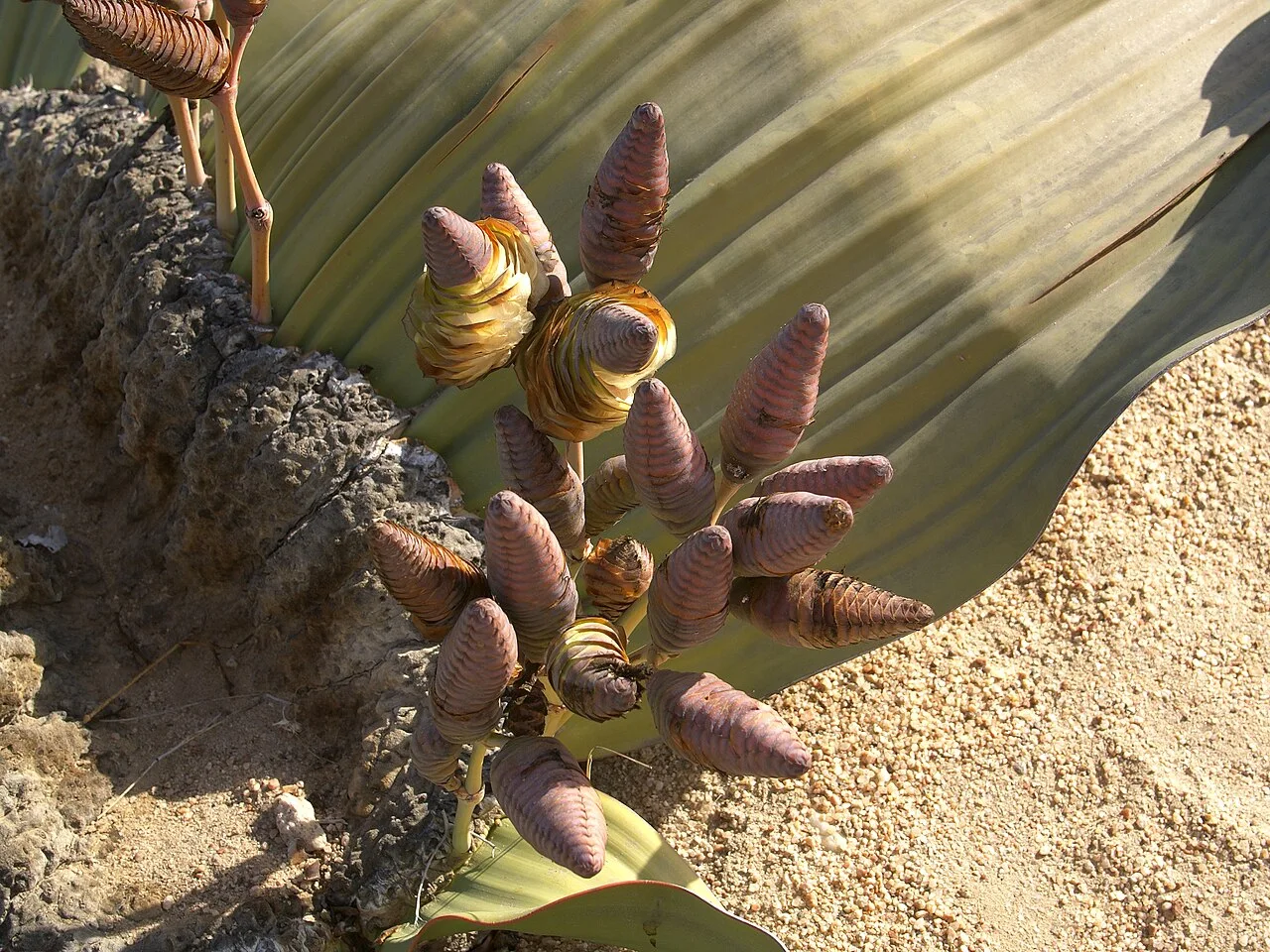
Welwitschia mirabilis (female).jpg · Resized and converted to WebP for display. Detail of a female plant and its reproductive structures. AI-generated illustration. Hans Hillewaert · CC BY-SA 4.0

Field guide · species
Welwitschia
Welwitschia mirabilis Hook.f., 1862
Welwitschia is a desert gymnosperm famous for keeping the same pair of foliage leaves throughout adult life. Those leaves continue growing at their bases and split into weathered ribbons.
Public research profile · final editorial review pending.
Tree of lifeScientific lineage
- LifeLife
- DomainEukaryota
- KingdomViridiplantae
- PhylumStreptophyta
- ClassGnetopsida
- OrderWelwitschiales
- FamilyWelwitschiaceae
- GenusWelwitschia
- SpeciesWelwitschia mirabilis
Advanced classification
Complete source lineage, including intermediate ranks. The standard view uses Life and the eight principal ranks.
- cellular organisms cellular root
- Eukaryota domain
- Viridiplantae kingdom
- Streptophyta phylum
- Streptophytina subphylum
- Embryophyta clade
- Tracheophyta clade
- Euphyllophyta clade
- Spermatophyta clade
- Acrogymnospermae clade
- Gnetopsida class
- Gnetidae subclass
- Welwitschiales order
- Welwitschiaceae family
- Welwitschia genus
- Welwitschia mirabilis species
Structure and identification
A low, woody stem supports two long strap-like leaves. Torn leaf tips can create the impression of many leaves, although the underlying arrangement remains a pair.
Habitat and range
Arid landscapes of the Namib region expose plants to intense sun, wind and scarce, irregular water.
Nutrition and metabolism
The persistent green leaves carry out photosynthesis. Water availability includes moisture in the soil; the plant should not be described as depending exclusively on direct fog absorption.
Reproduction and life cycle
Male and female cones occur on different plants. Insects visit the reproductive structures, and winged seeds provide a means of dispersal.
Geographic distribution
Native to Namibia and Angola. Its unusual form belongs to a geographically restricted desert lineage.
Ecological role
Its survival strategy illustrates a distinctive response to desert conditions, rather than a plant that has stopped evolving.
Distinctive adaptations
Continued growth from protected leaf bases allows the same foliage to persist despite damage at its exposed ends.
Evidence
Sources
- Welwitschia mirabilis · NCBI Taxonomy ↗www.ncbi.nlm.nih.gov
- Welwitschia mirabilis · Biological reference ↗pza.sanbi.org
- Welwitschia mirabilis · Biological reference ↗www.nparks.gov.sg
Connected life
Relationships
No reviewed ecological connections in the collection yet.
Explore network ↗