 Living Beings
 Framed for display
Compare species
Great hammerhead shark
Sphyrna mokarran
Scalloped Hammerhead
Sphyrna lewini
Try a comparison
How to compare two organisms
Choose two species and trace their closest shared group. Then compare a trait with the same definition on each side. Check the units, life stage and context before interpreting a measurement or range.
Missing data means that the collection lacks a sourced value. Where a characteristic does not apply to a lineage, the comparison labels it separately. Open the two profiles for context and follow their sources before drawing a conclusion.
Biological comparison
Means, ranges and reported maxima describe different things. Check the source and population before comparing values.
Classification
Shared ancestry
Closest shared taxon · Sphyrna.
- LifeLife
- DomainEukaryota
- KingdomAnimalia
- PhylumChordata
- ClassChondrichthyes
- OrderCarcharhiniformes
- FamilyCarcharhinidae
- GenusSphyrna
Separate lineages
Great hammerhead sharkspeciesSphyrna mokarran
Scalloped HammerheadspeciesSphyrna lewini
| Characteristic | Great hammerhead shark | Scalloped Hammerhead |
|---|---|---|
Scientific measurements | Scientific measurements | |
| Total length |
Recorded scopes or statistics differ.
6.1 m
Reported maximum · Context-specific record Source and measurement contextUpper end of published maximum total-length estimates. This is not typical adult size. · ≈ 20 ft Total length to the tip of the tail, as reported by the fisheries source.
|
Recorded scopes or statistics differ.
4.2 m
Reported maximum · Context-specific record Source and measurement contextUpper end of the published maximum total-length range. · ≈ 14 ft Total length to the tip of the tail, as reported by the fisheries source.
|
| Total length at maturity |
2.25 m
Approximate value · Male · At sexual maturity · Northern Australia · Fishery samples · Context-specific record Source and measurement contextUsual total length at maturity reported from northern Australian fishery samples. · ≈ 7.38 ft Total length associated with sexual maturity in the source population.
2.10 m
Approximate value · Female · At sexual maturity · Northern Australia · Fishery samples · Context-specific record Source and measurement contextUsual total length at maturity reported from northern Australian fishery samples. · ≈ 6.89 ft Total length associated with sexual maturity in the source population.
|
1.50 m
Approximate value · Male · At sexual maturity · Northern Australia · Fishery samples · Context-specific record Source and measurement contextUsual total length at maturity reported from northern Australian fishery samples. · ≈ 4.92 ft Total length associated with sexual maturity in the source population.
2.00 m
Approximate value · Female · At sexual maturity · Northern Australia · Fishery samples · Context-specific record Source and measurement contextUsual total length at maturity reported from northern Australian fishery samples. · ≈ 6.56 ft Total length associated with sexual maturity in the source population.
|
Natural history | Natural history | |
| Nutrition and energy acquisition |
Nutrition
Carnivorous Source ↗
The great hammerhead eats fish and invertebrates. Rays are a documented part of its diet. Observations document use of the …The great hammerhead eats fish and invertebrates. Rays are a documented part of its diet. Observations document use of the broad head to pin a stingray against the bottom during an attack. That behavior describes one way it handles prey within a much broader diet. |
Nutrition
No comparable measurement recorded
Fish and cephalopods are important prey. Feeding changes as sharks move from coastal juvenile habitat to deeper waters. Source 1 ↗ |
| Habitat |
It occurs in warm coastal and offshore waters. Records span shallow inshore sites and waters beyond the continental shelf. Reef …It occurs in warm coastal and offshore waters. Records span shallow inshore sites and waters beyond the continental shelf. Reef margins and nearby sandy areas provide examples of places where divers may encounter the species. |
Coastal shelves, island slopes and offshore waters are used at different ages and times. Source 1 ↗ |
| Geographic distribution |
Telemetry of tagged great hammerheads in the southeastern United States records seasonal movements and periods of repeated use of particular …Telemetry of tagged great hammerheads in the southeastern United States records seasonal movements and periods of repeated use of particular areas. A capture location documents where a shark was encountered. Tracking observations give a richer view of how the animal uses its range over time. |
The species occurs in warm seas around the world. Its presence is uneven, and local populations can be strongly depleted. Source 1 ↗ |
| Morphology |
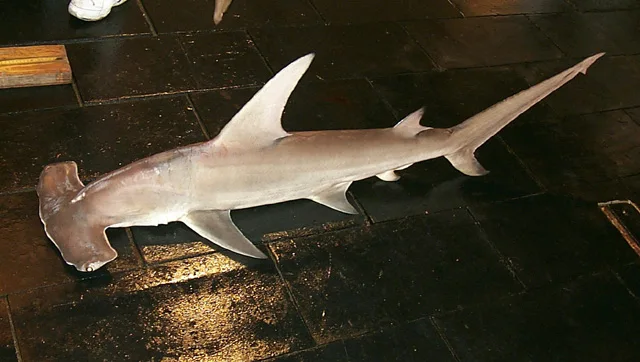
The flattened head is called a cephalofoil. A tall first dorsal fin is another useful identification feature. The first dorsal …The flattened head is called a cephalofoil. A tall first dorsal fin is another useful identification feature. The first dorsal fin is high and curved backwards. Compare that fin and the nearly straight front of the broad head together. Other hammerheads have a different pattern of curves or notches along the front margin, so head width alone is a poor field identification character. |
The head is broad and flattened, with a curved, indented front margin. The body has a tall first dorsal fin and a pale underside. Source 1 ↗ |
| Reproduction and life cycle |
Great hammerheads bear live young. The developing embryos are nourished through a yolk-sac placenta before birth. This reproductive strategy differs from the egg cases laid by some other sharks. Source 1 ↗ |
Females give birth to live young. Shallow coastal habitats provide nursery areas for juveniles. Source 1 ↗ |
| Ecological role |
|
These sharks are large marine predators and also host parasites and visiting cleaner fish. Source 1 ↗ |
| Behavior and activity |
No separate account recorded |
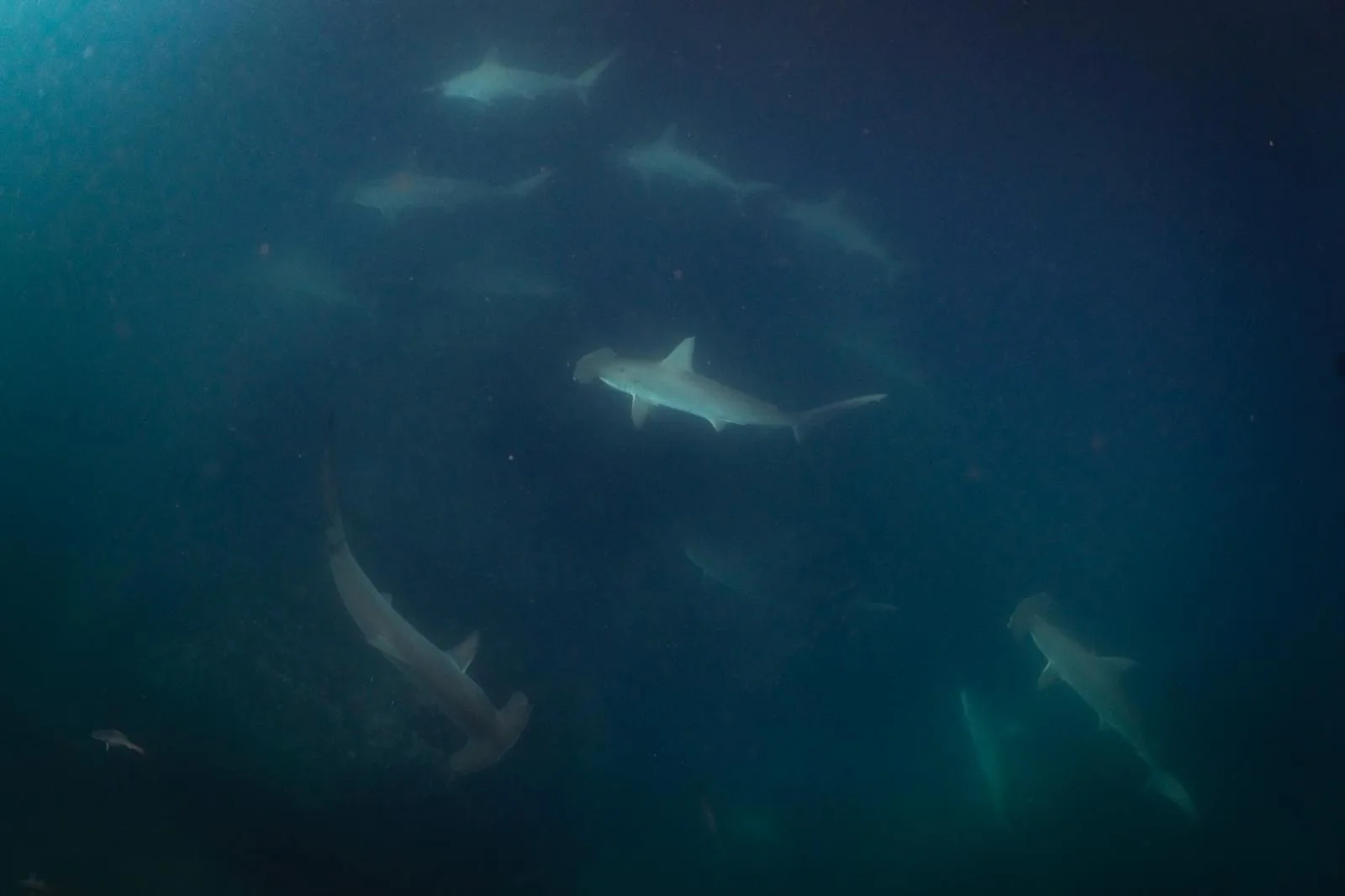
Schooling and movements between daytime gathering sites and feeding areas are characteristic in some populations. Source 1 ↗ |
| Environmental adaptations |
No separate account recorded |
The expanded head spreads sensory organs across a broad surface, supporting prey detection. Source 1 ↗ |
| Conservation |
No separate account recorded |
Targeted fishing, bycatch and loss of nursery habitat are major pressures. Protection needs to consider more than adult aggregation sites. Source 1 ↗ |
Sources from both profiles
More comparisons
Framed for display
