 Living Beings
 1 / 1
Wikimedia Commons photograph; resized for display. AI-generated illustration. NOAA / NMFS / Mississippi Laboratory · CC BY 3.0

Field guide · species
Great hammerhead shark
Sphyrna mokarran (Ruppell, 1837)
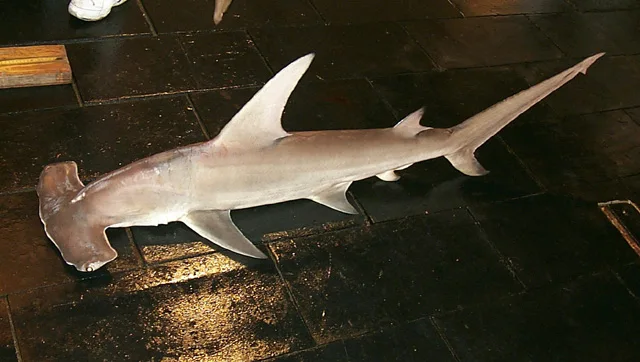
The great hammerhead is the largest hammerhead species. The front margin of its broad head is nearly straight, with a notch in the center.
Tree of lifeScientific lineage
- LifeLife
- DomainEukaryota
- KingdomAnimalia
- PhylumChordata
- ClassChondrichthyes
- OrderCarcharhiniformes
- FamilyCarcharhinidae
- GenusSphyrna
- SpeciesSphyrna mokarran
Advanced classification
Complete source lineage, including intermediate ranks. The standard view uses Life and the eight principal ranks.
- cellular organisms cellular root
- Eukaryota domain
- Opisthokonta clade
- Metazoa kingdom
- Eumetazoa clade
- Bilateria clade
- Deuterostomia clade
- Chordata phylum
- Craniata subphylum
- Vertebrata clade
- Gnathostomata clade
- Chondrichthyes class
- Elasmobranchii subclass
- Selachii infraclass
- Galeomorphii clade
- Galeoidea superorder
- Carcharhiniformes order
- Carcharhinidae family
- Sphyrna genus
- Sphyrna mokarran species
Physical traits
The flattened head is called a cephalofoil. A tall first dorsal fin is another useful identification feature.
Habitat and range
It occurs in warm coastal and offshore waters.
Diet and nutrition
The great hammerhead eats fish and invertebrates. Rays are a documented part of its diet.
Evidence
Sources
- GBIF Backbone Taxonomy ↗GBIF Secretariat
- Great hammerhead shark · Species reference ↗Florida Museum of Natural History
Connected life
Relationships
- Lives in Warm coastal waters · Source