 Living Beings
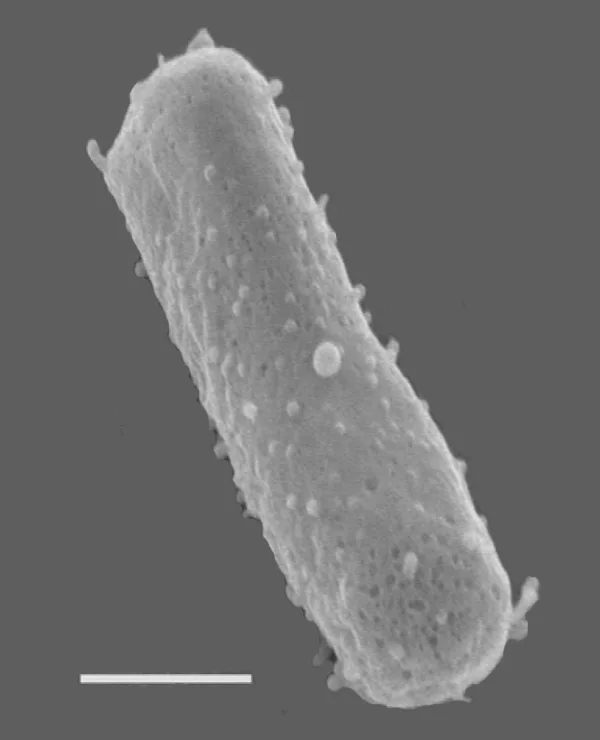
Halobacterium salinarum NRC-1.png · Resized and converted to WebP for display. Source-identified documentary image; see the original file for method and context. AI-generated illustration. Helga Stan-Lotter and Sergiu Fendrihan. Photograph taken by Chris Frethem, University of Minnesota. · CC BY-SA 4.0

Field guide · species
Halobacterium salinarum
corrig. (Harrison and Kennedy 1922) Elazari-Volcani 1957 (Approved Lists 1980) emend. Gruber et al. 2004
Despite its historical genus name, Halobacterium salinarum is an archaeon. High-salt growth and light-sensitive membrane proteins make it a classic example of how archaeal physiology differs from the familiar examples of animals and plants.
Public research profile · final editorial review pending.
Tree of lifeScientific lineage
- LifeLife
- DomainArchaea
- KingdomMethanobacteriati
- PhylumMethanobacteriota
- ClassHalobacteria
- OrderHalobacteriales
- FamilyHalobacteriaceae
- GenusHalobacterium
- SpeciesHalobacterium salinarum
Advanced classification
Complete source lineage, including intermediate ranks. The standard view uses Life and the eight principal ranks.
- cellular organisms cellular root
- Archaea domain
- Methanobacteriati kingdom
- Methanobacteriota phylum
- Stenosarchaea group clade
- Halobacteria class
- Halobacteriales order
- Halobacteriaceae family
- Halobacterium genus
- Halobacterium salinarum species
Structure and identification
Cells are typically rod-shaped, and pigmented cultures can appear red or pink. Neither color nor salty habitat alone establishes species identity.
Habitat and range
Highly saline environments provide the conditions associated with this halophilic archaeon.
Nutrition and metabolism
Organic nutrients support metabolism. In studied strains, bacteriorhodopsin can use light to drive a proton gradient without chlorophyll-based photosynthesis.
Biological activity
Sensory and signal-transduction systems allow responses to environmental cues, including light.
Reproduction and life cycle
Cells grow and divide under suitable salt and nutrient conditions. Research strains are maintained as defined lineages for genetic comparison.
Geographic distribution
Authenticated isolates document occurrence in salt-associated environments. The NRC-1 genome describes a particular strain, not all organisms in a salt pond.
Ecological role
The organism is part of specialized hypersaline microbial communities rather than evidence that every archaeon requires extreme conditions.
Distinctive adaptations
The NRC-1 genome contains systems for potassium uptake and sodium-proton exchange, as well as photosensory signaling. These findings connect salt adaptation with controlled ion movement across the membrane. Its surface resemblance to some bacteria does not change the archaeal ancestry demonstrated by its cellular and genetic machinery.
Evidence
Sources
- Halobacterium salinarum · NCBI Taxonomy ↗NCBI
- Light-independent phospholipid scramblase activity of bacteriorhodopsin from Halobacterium salinarum ↗Scientific reports · 2017
- Genome sequence of Halobacterium species NRC-1 ↗Proceedings of the National Academy of Sciences of the United States of America · 2000
Connected life
Relationships
No reviewed ecological connections in the collection yet.
Explore network ↗