 Living Beings
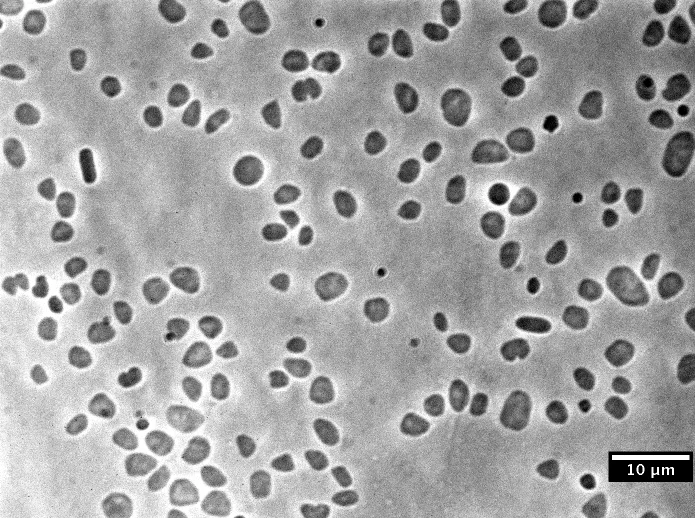
Haloferax volcanii.png · Resized and converted to WebP for display. Source-identified documentary image; see the original file for method and context. AI-generated illustration. Yejineun · CC BY-SA 3.0

Field guide · species
Haloferax volcanii
(Mullakhanbhai and Larsen 1975) Torreblanca et al. 1986
Haloferax volcanii is a salt-loving archaeon used extensively in genetics and cell biology. Its tractable culture system and complete genome make it valuable for studying both halophily and general features of archaeal cells.
Public research profile · final editorial review pending.
Tree of lifeScientific lineage
- LifeLife
- DomainArchaea
- KingdomMethanobacteriati
- PhylumMethanobacteriota
- ClassHalobacteria
- OrderHalobacteriales
- FamilyHaloferacaceae
- GenusHaloferax
- SpeciesHaloferax volcanii
Advanced classification
Complete source lineage, including intermediate ranks. The standard view uses Life and the eight principal ranks.
- cellular organisms cellular root
- Archaea domain
- Methanobacteriati kingdom
- Methanobacteriota phylum
- Stenosarchaea group clade
- Halobacteria class
- Halobacteriales order
- Haloferacaceae family
- Haloferax genus
- Haloferax volcanii species
Structure and identification
Cells require microscopy for observation. The sequenced type strain DS2 carries a main chromosome, three smaller chromosomes and a plasmid. Those DNA elements are not membrane-bound nuclei. Their organization helps explain why studying an archaeon involves more than treating it as a small version of a familiar bacterium.
Habitat and range
Saline environments and appropriately salt-rich culture media support growth.
Nutrition and metabolism
Organic nutrients can support growth in simple defined media. Salt balance is a physiological requirement rather than a food source.
Biological activity
Cellular responses to salt and available resources are studied using a developed genetic toolkit.
Reproduction and life cycle
Cells multiply through division. Experiments can follow inherited genetic changes through successive generations of a culture.
Geographic distribution
The type strain DS2 is a defined reference for genomic work. Worldwide use in laboratories is separate from the distribution of environmental populations.
Ecological role
Its life in saline microbial communities provides a contrast with the marine ammonia oxidizers and gut methanogens elsewhere in Archaea.
Distinctive adaptations
Salt-adapted physiology and a multipartite genome are important features of the reference strain.
Evidence
Sources
- Haloferax volcanii · NCBI Taxonomy ↗NCBI
- Haloferax volcanii for biotechnology applications: challenges, current state and perspectives ↗Applied microbiology and biotechnology · 2020
- The complete genome sequence of Haloferax volcanii DS2, a model archaeon ↗PloS one · 2010
Connected life
Relationships
No reviewed ecological connections in the collection yet.
Explore network ↗