 Living Beings
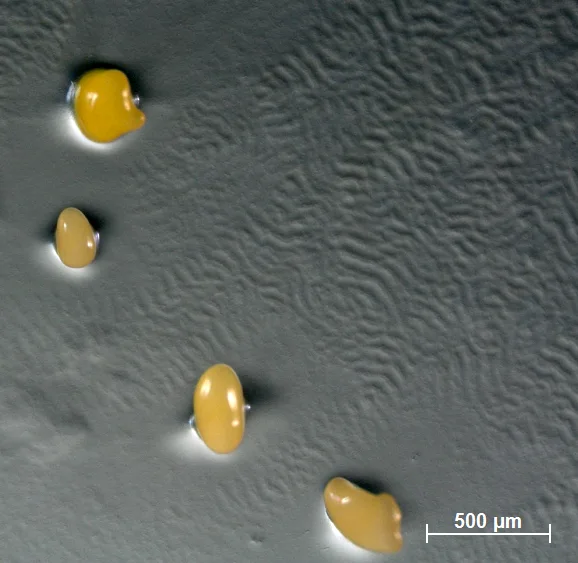
Myxococcus xanthus fruiting bodies and rippling.png · Resized and converted to WebP for display. Culture showing fruiting bodies and rippling behavior. AI-generated illustration. Ronald Garcia · CC BY-SA 4.0

Field guide · species
Myxococcus xanthus
Beebe 1941 (Approved Lists 1980)
Myxococcus xanthus is a social, surface-associated bacterium. Moving groups feed on other bacteria and can organize into fruiting bodies containing resistant spores.
Public research profile · final editorial review pending.
Tree of lifeScientific lineage
- LifeLife
- DomainBacteria
- KingdomPseudomonadati
- PhylumMyxococcota
- ClassMyxococcia
- OrderMyxococcales
- FamilyMyxococcaceae
- GenusMyxococcus
- SpeciesMyxococcus xanthus
Advanced classification
Complete source lineage, including intermediate ranks. The standard view uses Life and the eight principal ranks.
- cellular organisms cellular root
- Bacteria domain
- Pseudomonadati kingdom
- Myxococcota phylum
- Myxococcia class
- Myxococcales order
- Cystobacterineae suborder
- Myxococcaceae family
- Myxococcus genus
- Myxococcus xanthus species
Structure and identification
Individual cells are microscopic rods. The yellowish aggregates and rippling patterns in culture arise from the coordinated behavior of many cells, not from a single giant bacterium.
Habitat and range
It is studied on surfaces and can be isolated from environmental material. Its behavior depends on contact with a substrate and neighboring cells.
Nutrition and metabolism
Cells obtain nutrients by predation on other bacteria and by processing organic material released from prey.
Biological activity
Gliding, collective movement and rippling are experimentally observed features of the life cycle. The patterns reflect interactions among moving cells.
Reproduction and life cycle
When conditions favor development, cells aggregate and differentiate into spores within fruiting bodies. Germination returns cells to the growing, motile state.
Ecological role
Predation changes microbial communities and recycles nutrients at a microscopic scale.
Distinctive adaptations
Experiments disrupting polyphosphate metabolism impair movement, predation and development, illustrating how cellular chemistry supports collective behavior.
Evidence
Sources
- Myxococcus xanthus · NCBI Taxonomy ↗www.ncbi.nlm.nih.gov
- Myxococcus xanthus · Biological reference ↗pubmed.ncbi.nlm.nih.gov
- Myxococcus xanthus · Biological reference ↗pubmed.ncbi.nlm.nih.gov
Connected life
Relationships
No reviewed ecological connections in the collection yet.
Explore network ↗