 Living Beings
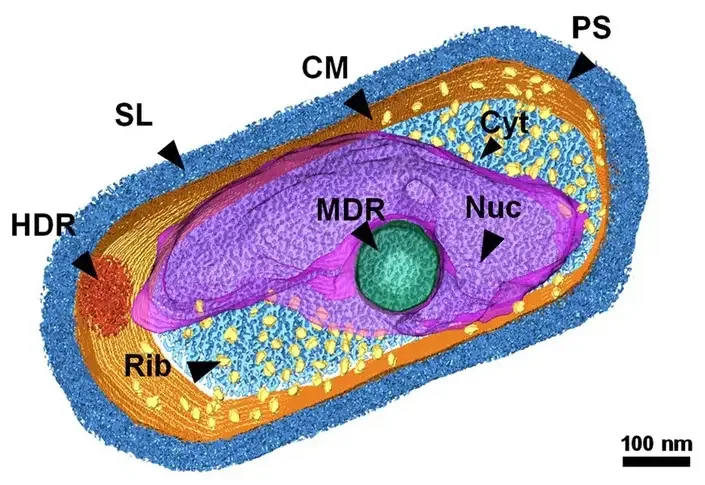
Fmicb-15-1367658-g001E.webp · Resized and converted to WebP for display. Cryo-electron tomographic reconstruction with segmented colors. AI-generated illustration. Yangkai Zhou, An Yan, Jiawen Yang, Wei He, Shuai Guo, Yifan Li, Jing Wu, Yanchao Dai, Xijiang Pan, Dongyu Cui, Olivier Pereira, Wenkai Teng, Ran Bi, Songze Chen, Lu Fan, Peiyi Wang, Yan Liao, Wei Qin, Sen-Fang Sui, Yuanqing Zhu, Chuanlun Zhang, Zheng Liu · CC BY 4.0

Field guide · species
Nitrosopumilus maritimus
Qin et al. 2017
Nitrosopumilus maritimus helped overturn the idea that cultivated Archaea were confined to extreme habitats. This marine archaeon obtains energy by oxidizing ammonia and builds biomass from inorganic carbon.
Public research profile · final editorial review pending.
Tree of lifeScientific lineage
- LifeLife
- DomainArchaea
- KingdomThermoproteati
- PhylumNitrososphaerota
- ClassNitrososphaeria
- OrderNitrosopumilales
- FamilyNitrosopumilaceae
- GenusNitrosopumilus
- SpeciesNitrosopumilus maritimus
Advanced classification
Complete source lineage, including intermediate ranks. The standard view uses Life and the eight principal ranks.
- cellular organisms cellular root
- Archaea domain
- Thermoproteati kingdom
- Nitrososphaerota phylum
- Nitrososphaeria class
- Nitrosopumilales order
- Nitrosopumilaceae family
- Nitrosopumilus genus
- Nitrosopumilus maritimus species
Structure and identification
Small cells require microscopic methods for study. Electron microscopy and tomography reveal cellular organization beyond what an ordinary photograph can show.
Habitat and range
Oxygen-containing marine conditions support ammonia oxidation. The original isolate came from an aquarium-associated marine system.
Nutrition and metabolism
This archaeon gains energy by oxidizing ammonia to nitrite and uses inorganic carbon to build cellular material. The original isolation demonstrated nitrification in an archaeon. Light is not the energy source for this carbon-fixing metabolism, distinguishing it from photosynthetic marine microbes.
Biological activity
Activity links energy metabolism to supplies of ammonia, oxygen and other required resources.
Reproduction and life cycle
Cell growth and division maintain cultured populations. Molecular and physiological evidence connect strain identity with measured activity.
Geographic distribution
The isolate is related to archaeal lineages detected widely in marine surveys. Related environmental sequences are not automatically exact species records.
Ecological role
Its metabolism links marine nitrogen transformations with carbon fixation.
Distinctive adaptations
The capacity for chemolithoautotrophy provides a route to growth without light-driven photosynthesis or an animal host.
Evidence
Sources
- Nitrosopumilus maritimus · NCBI Taxonomy ↗NCBI
- Microbe Profile: Nitrosopumilus maritimus ↗Microbiology (Reading, England) · 2022
- Isolation of an autotrophic ammonia-oxidizing marine archaeon ↗Nature · 2005
Connected life
Relationships
No reviewed ecological connections in the collection yet.
Explore network ↗