Tree height
Typical range · Mature
Source and measurement context
Usual height in undisturbed stands on good sites. · ≈ 66–98 ft
Vertical height of a mature tree in the source conditions.
- Stage
- Mature
Field guide · species
Quercus rubra L., 1753
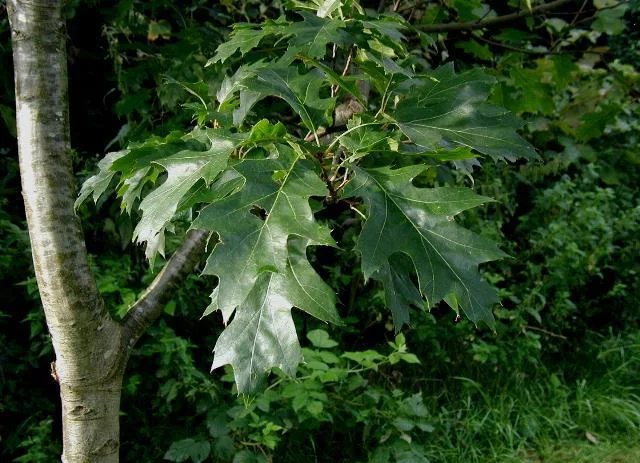
Northern red oak is a deciduous tree native to eastern and central North America. Its bristle-tipped leaves and acorns help distinguish it from other oaks.
Typical range · Mature
Usual height in undisturbed stands on good sites. · ≈ 66–98 ft
Vertical height of a mature tree in the source conditions.
Typical range · Mature
Diameter at breast height in undisturbed stands on good sites. · ≈ 24–36 in
Diameter at the conventional breast-height sampling point.
Reported range · Context-specific record
Blade length excluding the leaf stalk, as described by World Flora Online. · ≈ 0.39–0.66 ft
Length along an individual leaf.
Reported range · Context-specific record
Blade width in the same flora description. Size can vary within a tree. · ≈ 2–4.7 in
Width across the leaf blade, excluding the stalk.
The leaves have pointed lobes tipped with bristles. The acorns sit in shallow cups.
The bristle tips are small extensions at the ends of the lobes. Combine them with the shape of the acorn and its shallow cup when distinguishing northern red oak from other oaks. An isolated leaf is less informative than multiple characters from the same tree.
Northern red oak grows on a variety of forest sites and commonly occurs in mixed hardwood stands.
In the Forest Service account, good growth is associated with deep, well-drained soils. Site conditions vary with slope and aspect. When comparing two stands, soil moisture and depth are more informative than the presence of oak alone.
Northern red oak captures light energy with its leaves and fixes carbon by photosynthesis. In experiments comparing young northern red oaks and another oak species under shade, researchers measured both photosynthesis and how the seedlings allocated biomass. The results concern seedling responses in the study rather than a single light requirement for mature forest trees.
Its acorns develop over two growing seasons.
An acorn that ripens in autumn began development in the previous growing season. Acorns can germinate after winter, with a developing taproot helping the seedling establish below ground. Finding a seed crop does not guarantee establishment because many acorns are eaten or encounter unfavorable seedbed conditions.
Native to eastern and central North America.
Acorns provide food for wildlife. The population of small seedlings already present in the understory also matters for forest renewal. Silvicultural studies distinguish the production of seed from the survival and growth of young trees into canopy openings.
Northern red oak is Quercus rubra, one of the oaks commonly called red oak. Its alternate leaves have pointed, bristle-tipped lobes. Northern red oak often has shallower spaces between lobes than pin oak. On mature trunks, long pale ridges can stand out against darker bark. A broad, shallow acorn cup adds another clue. Compare several features together when similar oaks grow nearby.
Source for leaves, bark and acorns ↗Northern red oak acorns mature in their second growing season. After they fall, many are eaten or damaged. Some that escape losses overwinter and germinate the following spring. The acorn and its shallow cup can help identify the tree alongside its leaves and bark.
Source for when acorns mature ↗Northern red oak is native to eastern North America. People introduced it to Europe for ornamental planting and forestry. A study of introduced stands in seven European countries found that they were genetically closer to sampled populations in the northern part of the species' native range. Northern red oak is considered invasive in some parts of Europe, where it can regenerate and spread beyond planted stands. Local assessments depend on geography and the forests affected.
Source for native and introduced forests ↗Evidence
Connected life
Explore source-linked study observations, habitat records and classification in the focal network.