 Living Beings
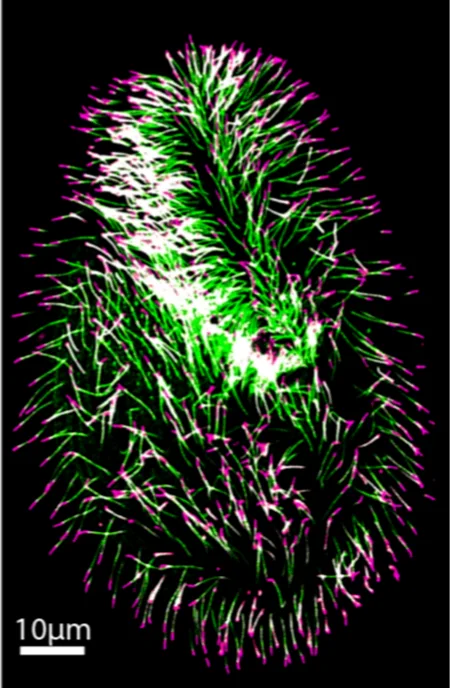
Paramecium tetraurelia Cilias.png · Resized and converted to WebP for display. Fluorescence microscopy; labeling colors are not natural body colors. AI-generated illustration. Gogendeau D., Lemullois M., Le Borgne P., Castelli M., Aubusson-Fleury A., Arnaiz O., Cohen J., Vesque C., Schneider-Maunoury S., Bouhouche K., Koll F., Tassin A-M. · CC BY 4.0

Field guide · species
Paramecium tetraurelia
Sonneborn, 1975
Paramecium tetraurelia is a ciliated single-celled eukaryote within the Paramecium aurelia species complex. Its nuclear organization and history of genome duplication make it important for understanding inheritance beyond familiar animal examples.
Public research profile · final editorial review pending.
Tree of lifeScientific lineage
- LifeLife
- DomainEukaryota
- PhylumCiliophora
- ClassOligohymenophorea
- OrderPeniculida
- FamilyParameciidae
- GenusParamecium
- SpeciesParamecium tetraurelia
Advanced classification
Complete source lineage, including intermediate ranks. The standard view uses Life and the eight principal ranks.
- cellular organisms cellular root
- Eukaryota domain
- Sar clade
- Alveolata clade
- Ciliophora phylum
- Intramacronucleata subphylum
- Oligohymenophorea class
- Peniculida order
- Parameciidae family
- Paramecium genus
- Paramecium tetraurelia species
Structure and identification
A ciliated, elongated cell body carries an oral feeding region. Closely related members of the species complex can be difficult to separate by appearance alone.
Habitat and range
Freshwater conditions with microbial food support growth in nature and in appropriately prepared cultures.
Nutrition and metabolism
Ciliary activity directs suspended food toward the oral region, where particles enter food vacuoles.
Biological activity
Coordinated beating of cilia supports swimming and feeding, while sensory responses alter movement.
Reproduction and life cycle
Vegetative fission coexists with processes involving germline and somatic nuclei. Nuclear inheritance cannot be reduced to a simple animal-style model.
Geographic distribution
Species identity must be checked within the aurelia complex. A generic Paramecium observation is not automatically a P. tetraurelia record.
Ecological role
Feeding on microorganisms places the ciliate within freshwater microbial communities.
Distinctive adaptations
Genome analysis revealed at least three successive whole-genome duplications. Copies were not all lost at once: retention patterns differ among genes, with shared dosage requirements helping explain why some copies persist. This research distinguishes the history of its genome from the ordinary division of a cell during growth.
Evidence
Sources
Connected life
Relationships
No reviewed ecological connections in the collection yet.
Explore network ↗