 Living Beings
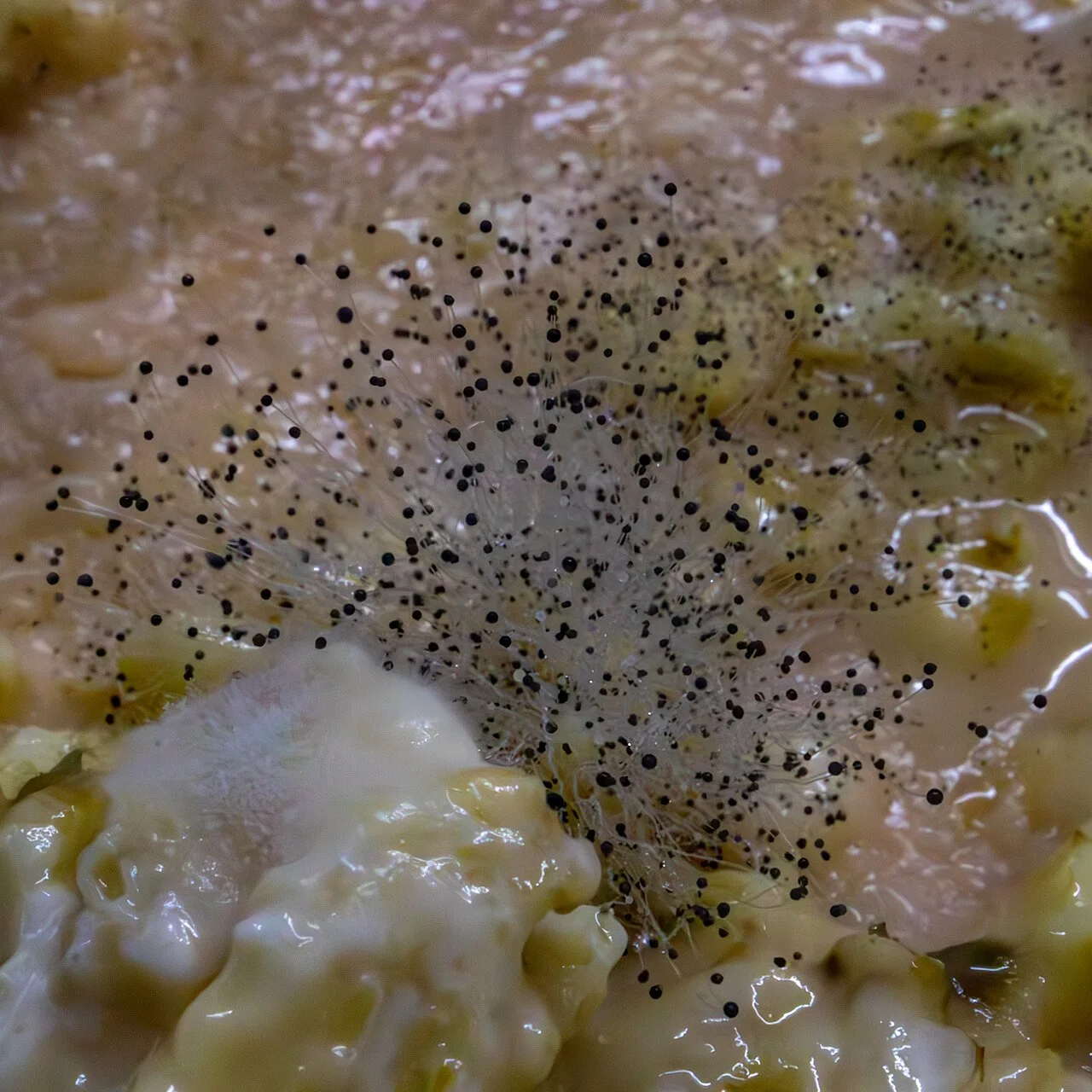
Алматы, Rhizopus stolonifer в овсянке на Кулымбетова (1).jpg · Resized and converted to WebP for display. Source-identified documentary image; see the original file for method and context. AI-generated illustration. Nikolai Bulykin · CC BY-SA 4.0

Field guide · species
Black Bread Mold
Rhizopus stolonifer (Ehrenb.) Vuill., 1902
Black bread mold spreads rapidly over suitable organic material. Its pale hyphae produce dark, rounded sporangia, giving a mature colony its familiar appearance without making colony color a sufficient identification test.
Public research profile · final editorial review pending.
Tree of lifeScientific lineage
- LifeLife
- DomainEukaryota
- KingdomFungi
- PhylumMucoromycota
- ClassMucoromycetes
- OrderMucorales
- FamilyRhizopodaceae
- GenusRhizopus
- SpeciesRhizopus stolonifer
Advanced classification
Complete source lineage, including intermediate ranks. The standard view uses Life and the eight principal ranks.
- cellular organisms cellular root
- Eukaryota domain
- Opisthokonta clade
- Fungi kingdom
- Fungi incertae sedis no rank
- Mucoromycota phylum
- Mucoromycotina subphylum
- Mucoromycetes class
- Mucorales order
- Mucorineae suborder
- Rhizopodaceae family
- Rhizopus genus
- Rhizopus stolonifer species
Structure and identification
Stolons spread across the substrate, with anchoring rhizoids and upright sporangiophores bearing rounded sporangia.
Habitat and range
Moist, nutrient-rich organic material, including damaged plant tissues, can support growth.
Nutrition and metabolism
The fungus absorbs products released from organic substrates, including sugars and starch-containing material.
Biological activity
Rapid hyphal extension spreads a colony; spores allow dispersal beyond the original substrate.
Reproduction and life cycle
Asexual spores form in sporangia. Compatible mating types can produce thick-walled sexual zygospores with a dormant phase.
Geographic distribution
Spores and substrate-associated records are widespread. An individual indoor colony still requires identification before being called this species.
Ecological role
Decomposition and spoilage connect its growth with nutrient release from plant-derived material.
Distinctive adaptations
A spreading stolon system and distinct resting and dispersal structures support different phases of its life.
Evidence
Sources
- Rhizopus stolonifer · NCBI Taxonomy ↗NCBI
- Photosensitization can be an effective risk-reduction strategy against the post-baking mold spoilage of bread ↗Food microbiology · 2024
- Rhizopus stolonifer — University of California, Davis, Enology ↗University of California, Davis, Enology
- Rhizopus stolonifer — US Department of Energy Joint Genome Institute ↗US Department of Energy Joint Genome Institute
Connected life
Relationships
No reviewed ecological connections in the collection yet.
Explore network ↗