 Living Beings
 1 / 1
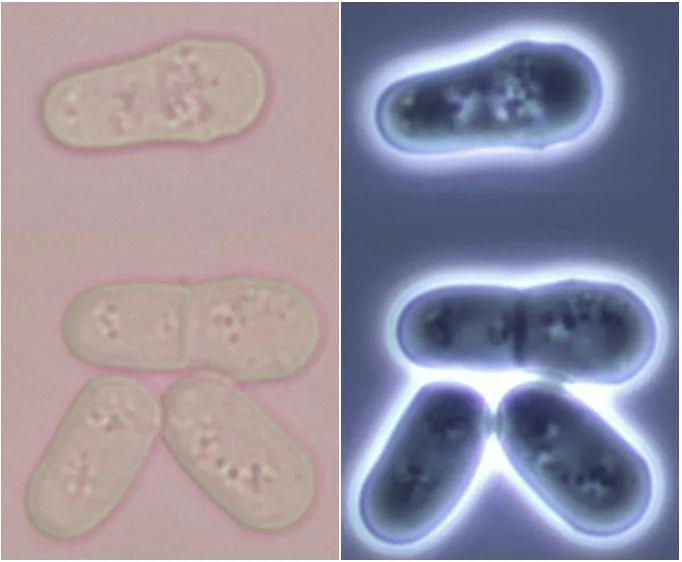
Schizosaccharomyces pombe division.JPG · Resized and converted to WebP for display. Source-identified documentary image; see the original file for method and context. AI-generated illustration. Roland Gromes · CC BY-SA 3.0

Field guide · species
Fission Yeast
Schizosaccharomyces pombe Lindner, 1893
Fission yeast is a single-celled fungus that divides across the middle rather than producing the unequal buds familiar in brewer's yeast. It is an important model for chromosome biology and the control of the eukaryotic cell cycle.
Public research profile · final editorial review pending.
Tree of lifeScientific lineage
- LifeLife
- DomainEukaryota
- KingdomFungi
- PhylumAscomycota
- ClassSchizosaccharomycetes
- OrderSchizosaccharomycetales
- FamilySchizosaccharomycetaceae
- GenusSchizosaccharomyces
- SpeciesSchizosaccharomyces pombe
Advanced classification
Complete source lineage, including intermediate ranks. The standard view uses Life and the eight principal ranks.
- cellular organisms cellular root
- Eukaryota domain
- Opisthokonta clade
- Fungi kingdom
- Dikarya subkingdom
- Ascomycota phylum
- Taphrinomycotina subphylum
- Schizosaccharomycetes class
- Schizosaccharomycetales order
- Schizosaccharomycetaceae family
- Schizosaccharomyces genus
- Schizosaccharomyces pombe species
Structure and identification
Cells are elongated, often with rounded ends. A dividing cell forms a transverse partition near its middle.
Habitat and range
The species has been recovered from fermentation-associated materials and is maintained on defined laboratory substrates.
Nutrition and metabolism
Organic nutrients, including sugars, support growth. Carbon source and nutrient availability influence physiology.
Biological activity
Cells extend at their tips and coordinate growth with nuclear division and septum formation.
Reproduction and life cycle
Vegetative cells reproduce by fission. Mating and meiosis under suitable conditions lead to spore formation.
Geographic distribution
Research and fermentation records occur in different regions, but these should not be treated as a complete map of natural populations.
Ecological role
The fungus forms part of microbial communities associated with organic substrates and fermentation.
Distinctive adaptations
A regular rod-shaped growth cycle has made changes in cell-cycle control experimentally observable.
Evidence
Sources
- Schizosaccharomyces pombe · NCBI Taxonomy ↗NCBI
- Synchronization of yeast cell populations ↗Methods in cell science : an official journal of the Society for In Vitro Biology · 1999
- The genome sequence of Schizosaccharomyces pombe ↗Nature · 2002
- Schizosaccharomyces pombe — PomBase ↗PomBase
Connected life
Relationships
No reviewed ecological connections in the collection yet.
Explore network ↗