 Living Beings
 Framed for display
Try a comparison
How to compare two organisms
Choose two species and trace their closest shared group. Then compare a trait with the same definition on each side. Check the units, life stage and context before interpreting a measurement or range.
Missing data means that the collection lacks a sourced value. Where a characteristic does not apply to a lineage, the comparison labels it separately. Open the two profiles for context and follow their sources before drawing a conclusion.
Biological comparison
Means, ranges and reported maxima describe different things. Check the source and population before comparing values.
Classification
Shared ancestry
Closest shared evolutionary group · Felinae.
Separate lineages
| Characteristic | Bay Cat | Bobcat |
|---|---|---|
Scientific measurements | Scientific measurements | |
| Body mass | No measurement recorded |
4–15 kg
Reported range Source and measurement contextSpecies account, descriptive range · ≈ 9–33 lb Mass of an individual animal.
|
| Tail length | No measurement recorded |
0.11–0.19 m
Reported range Source and measurement contextSpecies account, descriptive range · ≈ 0.36–0.62 ft Length of the tail alone.
|
| Head and body length | No measurement recorded |
0.65–1.05 m
Reported range Source and measurement contextSpecies account, descriptive range · ≈ 2.1–3.44 ft Head and body, excluding the tail.
|
Natural history | Natural history | |
| Nutrition and energy acquisition |
Published accounts report small mammals and birds among possible foods, but its wild diet is not comprehensively documented. Source 1 ↗Source 2 ↗ |
Rabbits, rodents and other small vertebrates are common prey. Larger or unusual prey may be taken opportunistically. Source 1 ↗Source 2 ↗ |
| Habitat |
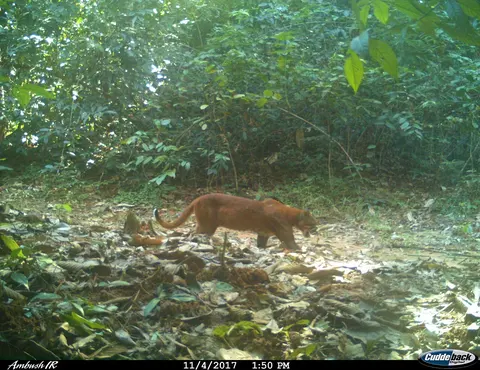
Forest habitats, including dense primary forest, are associated with its occurrence. Camera traps documented the bay cat in a heavily …Forest habitats, including dense primary forest, are associated with its occurrence. Camera traps documented the bay cat in a heavily logged commercial forest in Borneo. That evidence establishes use of the surveyed site. It leaves open how density and long-term survival compare with less disturbed forest. |
Forests, scrub, mountains and semi-open habitats can be occupied where shelter and food are available. Source 1 ↗Source 2 ↗ |
| Geographic distribution |
The Mammal Diversity Database v2.5 records this species in Brunei, Indonesia, Malaysia. Source 1 ↗Source 2 ↗ |
Bobcats range from southern Canada through much of the United States and into Mexico. Across that span they use scrub, …Bobcats range from southern Canada through much of the United States and into Mexico. Across that span they use scrub, forest and rocky terrain, including habitats outside the boreal range associated with Canada lynx. In areas where both cats occur, location can narrow the possibilities but features such as feet and tail markings are needed to distinguish them. |
| Morphology |
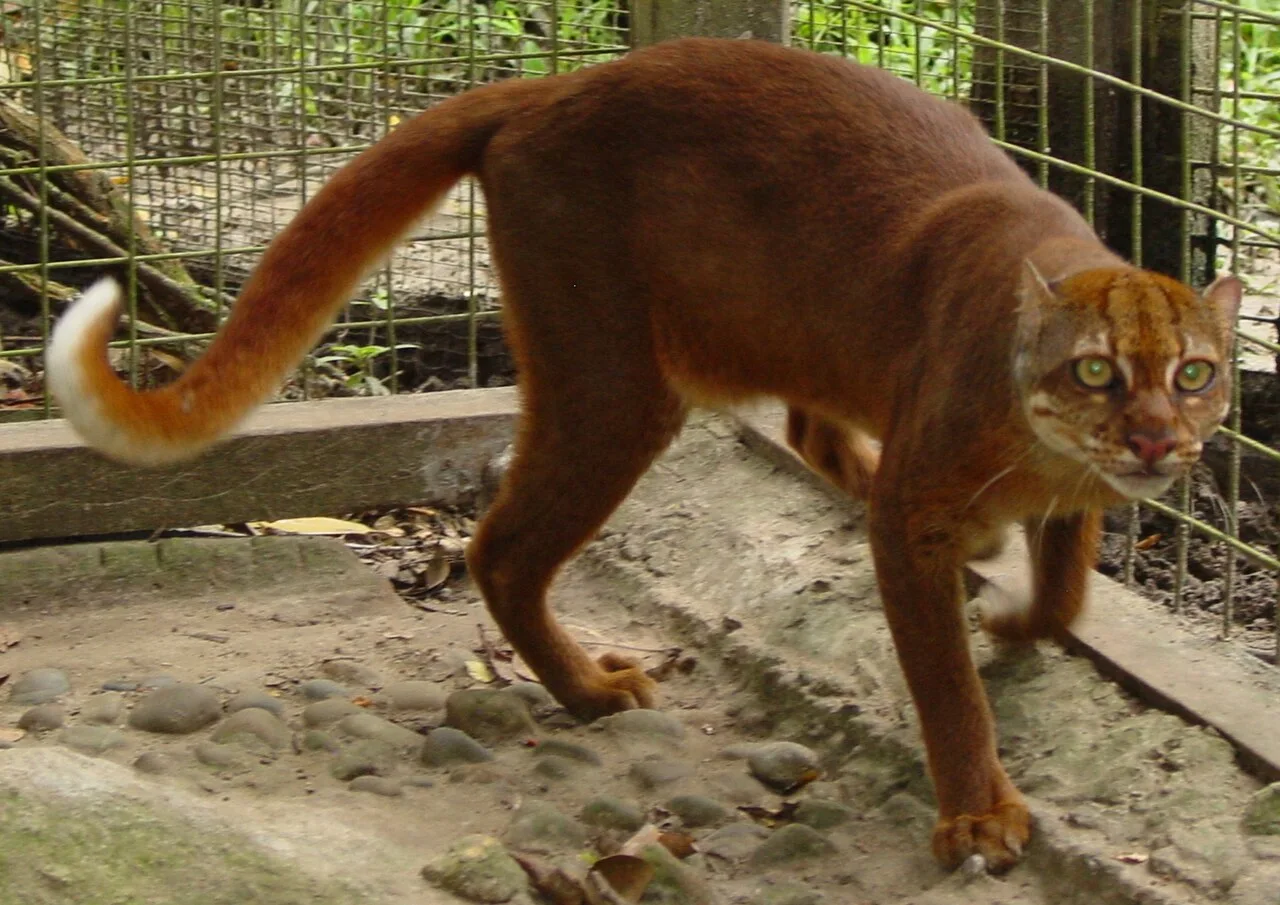
Reddish and grayish coats occur, with rounded ears and a relatively elongated tail. Source 1 ↗Source 2 ↗ |
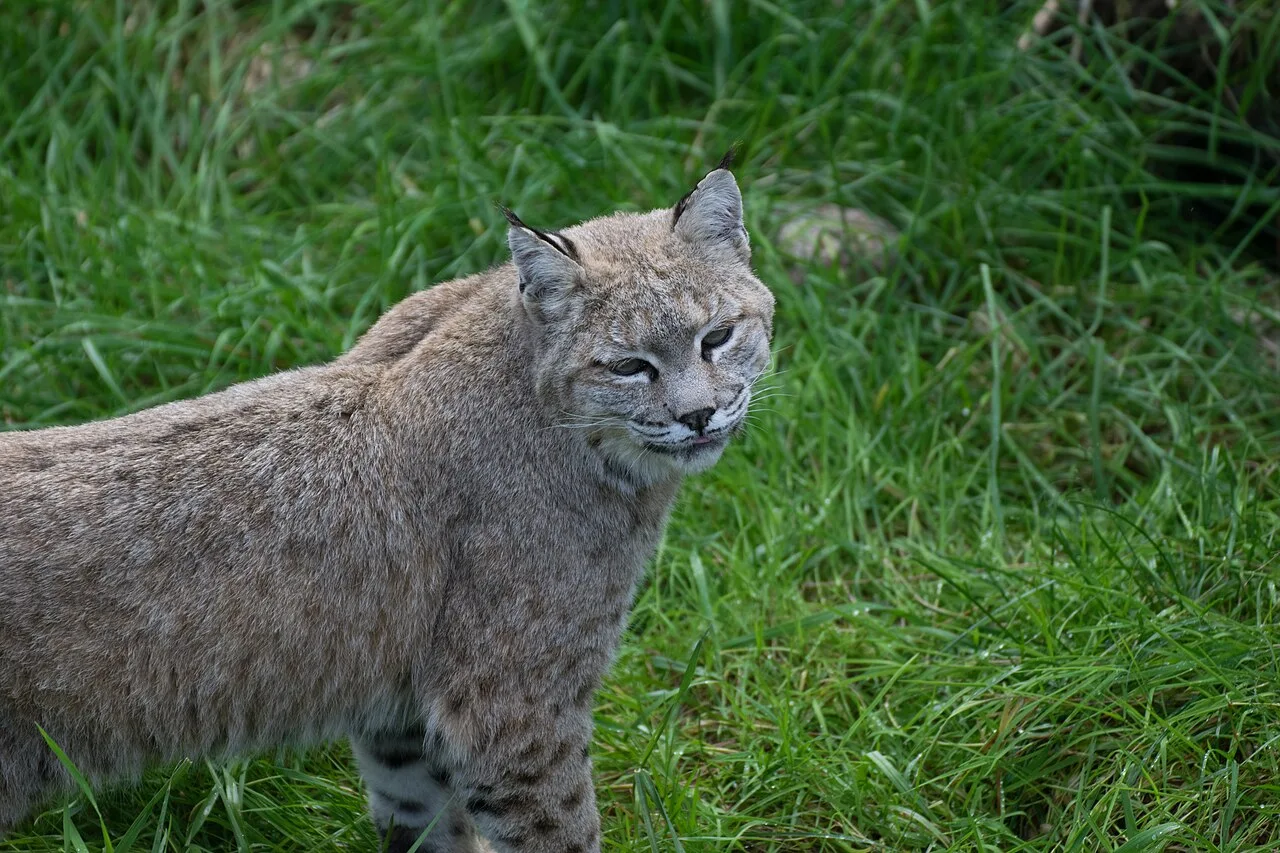
A short tail, facial ruff and spotted or streaked coat contribute to identification. Check the short tail along with the …A short tail, facial ruff and spotted or streaked coat contribute to identification. Check the short tail along with the ears and the markings on the legs. The bobcat has a dark area on top of the tail tip and pale fur below it, while the Canada lynx has a black tip all the way around. View the tail from more than one angle if the animal is moving. |
| Reproduction and life cycle |
No separate account recorded |
The female raises her kittens in a sheltered den. They begin eating solid food while still dependent on her and …The female raises her kittens in a sheltered den. They begin eating solid food while still dependent on her and learn to hunt before becoming independent. The species account describes dispersal during the first winter, commonly at about eight months. Litter size and development vary, so these timings describe a life-history pattern rather than a fixed timetable for every kitten. |
| Ecological role |
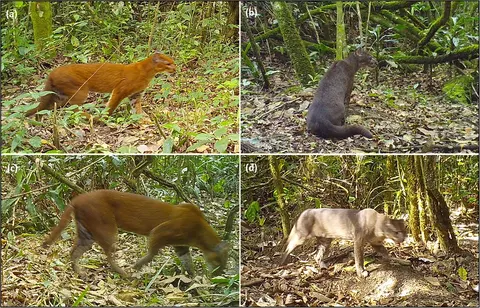
Survey placement affects what a camera records. A path used by researchers or other carnivores may miss an animal that …Survey placement affects what a camera records. A path used by researchers or other carnivores may miss an animal that usually travels elsewhere. The Bornean field study evaluated survey design as well as species detections, a distinction worth keeping when interpreting a rare cat’s apparent absence. |
No separate account recorded |
| Behavior and activity |
Its secretive life makes observations scarce. Reports of nighttime activity do not establish an unvarying schedule for every individual. Source 1 ↗Source 2 ↗ |
Bobcats generally live independently outside mating and mother–young associations. They stalk and pounce rather than pursuing prey over long distances. Source 1 ↗Source 2 ↗ |
Sources from both profiles
Bay Cat
More comparisons
Framed for display

 Framed for display

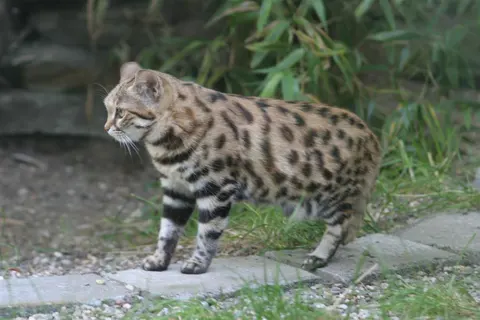 Framed for display
