 Living Beings
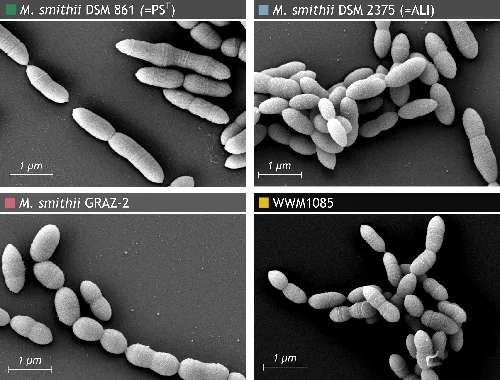
Methanobrevibacter smithii.png · Resized and converted to WebP for display. Source-identified documentary image; see the original file for method and context. AI-generated illustration. Viktoria Weinberger, Rokhsareh Mohammadzadeh, Marcus Blohs, Kerstin Kalt, Alexander Mahnert, Sarah Moser, Marina Cecovini, Polona Mertelj, Tamara Zurabishvili, Bhawna Arora, Jacqueline Wolf, Tejus Shinde, Tobias Madl, Hansjörg Habisch, Dagmar Kolb, Dominique Pernitsch, Kerstin Hingerl, William Metcalf and Christine Moissl-Eichinger · CC BY 4.0

Field guide · species
Methanobrevibacter smithii
Balch and Wolfe 1981
Methanobrevibacter smithii is a methane-producing archaeon associated with the human intestinal community. It consumes products generated by other microbes, placing its metabolism within a network of interactions rather than an isolated digestive process.
Public research profile · final editorial review pending.
Tree of lifeScientific lineage
- LifeLife
- DomainArchaea
- KingdomMethanobacteriati
- PhylumMethanobacteriota
- ClassMethanobacteria
- OrderMethanobacteriales
- FamilyMethanobacteriaceae
- GenusMethanobrevibacter
- SpeciesMethanobrevibacter smithii
Advanced classification
Complete source lineage, including intermediate ranks. The standard view uses Life and the eight principal ranks.
- cellular organisms cellular root
- Archaea domain
- Methanobacteriati kingdom
- Methanobacteriota phylum
- Methanomada group clade
- Methanobacteria class
- Methanobacteriales order
- Methanobacteriaceae family
- Methanobrevibacter genus
- Methanobrevibacter smithii species
Structure and identification
Small cells require microscopy and validated taxonomic methods for study. Closely related gut methanogens need careful strain-level discrimination.
Habitat and range
The oxygen-poor distal intestine provides a host-associated environment supplied with microbial fermentation products.
Nutrition and metabolism
Hydrogen-consuming methanogenesis uses products released by other community members, contributing to methane formation.
Biological activity
Surface glycans, adhesin-like proteins and nutrient competition help explain persistence in the intestinal environment.
Reproduction and life cycle
Cell multiplication occurs within suitable anaerobic conditions. Genomic comparisons distinguish strains and newly separated related species.
Geographic distribution
Human-derived isolates and genomic studies document host-associated occurrence. A person's carriage cannot be inferred from a species profile.
Ecological role
Removal of fermentation products can affect interactions among members of the gut microbial community.
Distinctive adaptations
The genome study identified surface glycans resembling those in the gut mucosa and regulated adhesin-like proteins. It also examined consumption of products made by carbohydrate-fermenting bacteria. These results explain potential mechanisms of persistence and microbial interaction; observations in experimental mice do not establish a health outcome for every human carrying this archaeon.
Evidence
Sources
- Methanobrevibacter smithii · NCBI Taxonomy ↗NCBI
- Expanding the cultivable human archaeome: Methanobrevibacter intestini sp. nov. and strain Methanobrevibacter smithii 'GRAZ-2' from human faeces ↗International journal of systematic and evolutionary microbiology · 2025
- Genomic and metabolic adaptations of Methanobrevibacter smithii to the human gut ↗Proceedings of the National Academy of Sciences of the United States of America · 2007
Connected life
Relationships
No reviewed ecological connections in the collection yet.
Explore network ↗