 Living Beings
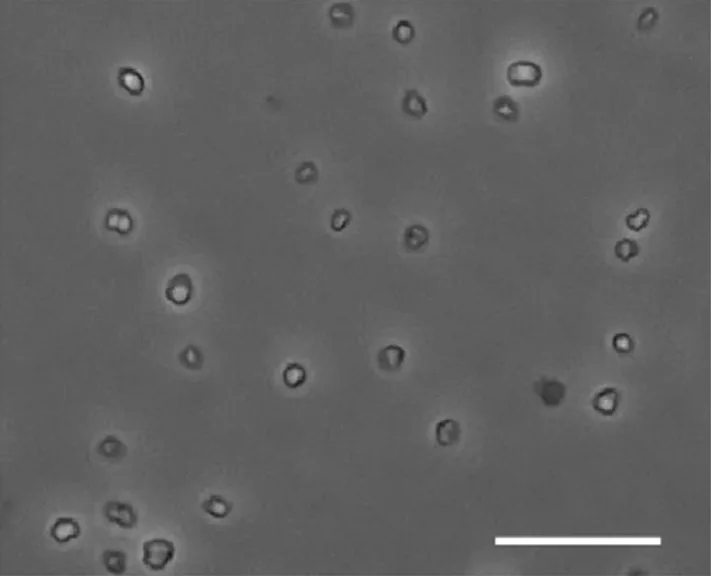
Ansa.202100042-Fig2-PDF-big (Methanocaldococcus jannaschii).png · Resized and converted to WebP for display. Light micrograph of cultured cells; source scale bar retained. AI-generated illustration. Nanako Kanno, Shingo Kato, Takashi Itoh, Moriya Ohkuma, Shinsuke Shigeto · CC BY 4.0

Field guide · species
Methanocaldococcus jannaschii
(Jones et al. 1984) Whitman 2002
Methanocaldococcus jannaschii is a heat-adapted, methane-producing archaeon first isolated from a submarine hydrothermal vent. It belongs to Archaea, a domain distinct from Bacteria.
Public research profile · final editorial review pending.
Tree of lifeScientific lineage
- LifeLife
- DomainArchaea
- KingdomMethanobacteriati
- PhylumMethanobacteriota
- ClassMethanococci
- OrderMethanococcales
- FamilyMethanocaldococcaceae
- GenusMethanocaldococcus
- SpeciesMethanocaldococcus jannaschii
Advanced classification
Complete source lineage, including intermediate ranks. The standard view uses Life and the eight principal ranks.
- cellular organisms cellular root
- Archaea domain
- Methanobacteriati kingdom
- Methanobacteriota phylum
- Methanomada group clade
- Methanococci class
- Methanococcales order
- Methanocaldococcaceae family
- Methanocaldococcus genus
- Methanocaldococcus jannaschii species
Structure and identification
Cells are microscopic and roughly spherical. The accompanying light micrograph shows cultured cells; their simple outline conceals specialized cellular chemistry.
Habitat and range
Hot, oxygen-poor conditions associated with seafloor hydrothermal systems provide the setting of the original isolate.
Nutrition and metabolism
Hydrogen supplies reducing power and carbon dioxide supplies carbon in its methane-producing metabolism. This is a chemical-energy strategy rather than photosynthesis.
Biological activity
Growth and metabolism are adapted to high-temperature culture conditions. Laboratory experiments examine how metals and sulfide influence survival.
Geographic distribution
The original description concerns a hydrothermal-vent isolate. It should not be treated as a complete survey of the species’ global range.
Ecological role
Methanogenesis links this archaeon to carbon cycling in environments without oxygen.
Distinctive adaptations
Experiments show that surrounding sulfide can influence metal toxicity. Survival therefore depends on environmental chemistry as well as temperature.
Evidence
Sources
Connected life
Relationships
No reviewed ecological connections in the collection yet.
Explore network ↗