Field guide · species

Escherichia coli

(Migula 1895) Castellani and Chalmers 1919 (Approved Lists 1980)

What does the authority mean?

The authority credits the formal scientific description of the name. A year records publication of that description.

Check the recorded name and authority ↗

Escherichia coli is a bacterial species found in many environments, including the intestines of people and other animals. Most types are harmless, while some can cause illness.

Tree of lifeScientific lineage
  1. LifeLife
  2. DomainBacteria
  3. KingdomPseudomonadati
  4. PhylumPseudomonadota
  5. ClassGammaproteobacteria
  6. OrderEnterobacterales
  7. FamilyEnterobacteriaceae
  8. GenusEscherichia
  9. SpeciesEscherichia coli

In brief

Habitat and range
E. coli can occur in intestinal tracts, water, food and other environments. Source ↗
Geographic distribution
Escherichia coli occurs in humans and other vertebrates, so its distribution is often described in terms of hosts and sampling sites. In one survey of more… Source ↗
Nutrition and metabolism
Escherichia coli derives carbon and energy from organic compounds. The laboratory lineage K-12 illustrates facultative anaerobic metabolism: researchers observed a shift between fermentation and respiration as… Source ↗

Scientific measurements

Cell length

1.94–2.72 µm

Reported range · Study strain E. coli B · Laboratory study · Context-specific record

Source and measurement context

Reported range across sample mean cell lengths in a laboratory study of a strain of E. coli B. The endpoints do not define the range of individual cells or of the species.

Length of a single cell under the reported conditions.

Population
Study strain E. coli B
Setting
Laboratory study
Method
Electron micrograph measurements summarized by sample
BioNumbers · Length of an E. coli cell ↗ Record 100001 v4, measured cell lengths

Structure and identification

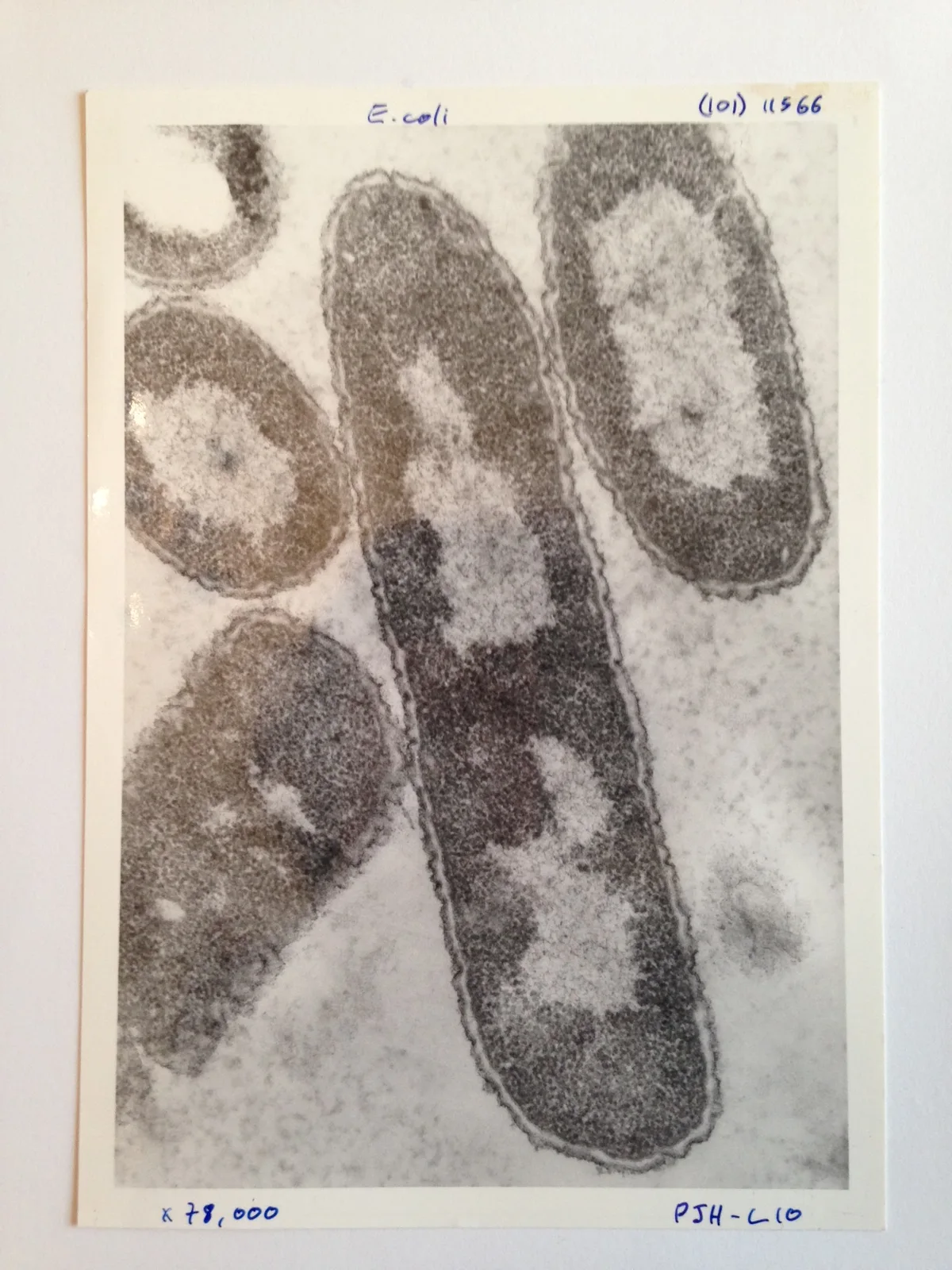
The species name refers to a group of bacteria whose strains cannot be distinguished by ordinary rod shape alone. A micrograph is useful for seeing cell form, but strain identity and gene content require other evidence.

Scientific source ↗

Habitat and range

E. coli can occur in intestinal tracts, water, food and other environments.

Water monitoring uses counts of E. coli as an indicator of fecal contamination. An indicator result describes conditions in a sampled body of water and cannot by itself identify a disease-causing strain or the origin of the contamination.

Scientific source ↗

Nutrition and metabolism

Escherichia coli derives carbon and energy from organic compounds. The laboratory lineage K-12 illustrates facultative anaerobic metabolism: researchers observed a shift between fermentation and respiration as oxygen availability changed. Metabolic findings from a named laboratory lineage should be interpreted in that strain context.

Scientific source ↗

Reproduction and life cycle

An E. coli cell reproduces by binary fission. As it divides, a partition called the septum forms between the two emerging daughter cells. A bacterial generation describes the interval between divisions, and it is a separate concept from the lifespan of an individual animal.

Scientific source ↗

Geographic distribution

Escherichia coli occurs in humans and other vertebrates, so its distribution is often described in terms of hosts and sampling sites. In one survey of more than 2,300 non-domesticated Australian vertebrates, the likelihood of detecting E. coli differed among host groups and with proximity to human habitation. That survey describes sampled hosts in Australia.

Scientific source ↗

Ecological role

Some E. coli types occur as ordinary members of intestinal microbial communities. Others carry traits associated with illness. The presence of the species name in a sample does not by itself identify the strain or establish that it caused disease.

Host association varies even among commensal E. coli within the same species. A study comparing sampled animal hosts found that broad bacterial lineages occurred at different relative abundances among hosts. The population represented in one host therefore gives a limited picture of the diversity present in others.

Scientific source 1 ↗ · Scientific source 2 ↗

Distinctive adaptations

A genome comparison between an O157:H7 strain and a laboratory K-12 strain found shared sequence alongside regions specific to each lineage. The shared part helps explain why they are related. The differences help explain why observations about one strain should be reported with its strain name instead of being assigned to every E. coli cell.

Scientific source ↗

Species guide

E. coli and its cell size

E. coli is the abbreviation of Escherichia coli, a Gram-negative rod-shaped bacterium in Enterobacteriaceae. The length record below refers to one documented research strain. Cells can differ in size across growth states and study samples. A micrometre is a thousandth of a millimetre.

Source for e. coli and its cell size ↗

One species, many strains

Many E. coli strains normally occur in the intestines of humans and other animals. The species contains considerable diversity, and a disease association for one strain does not describe all E. coli. A microscope image can show the shape and arrangement of cells while leaving their strain identity unknown.

Source for one species, many strains ↗

Evidence

Sources

Connected life

No reviewed ecological connections in the collection yet.