 Living Beings
 Framed for display
Compare species
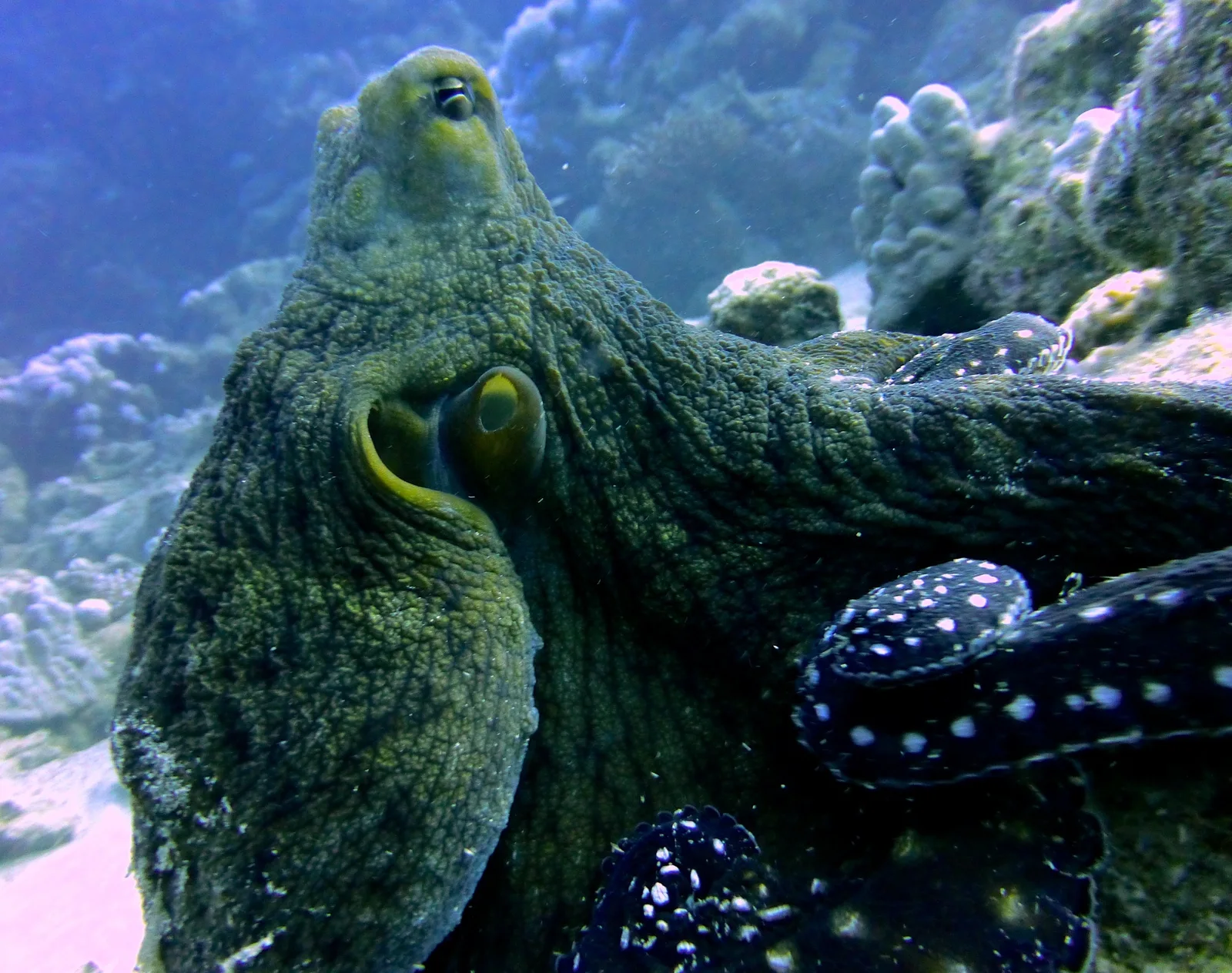
Day Octopus
Octopus cyanea
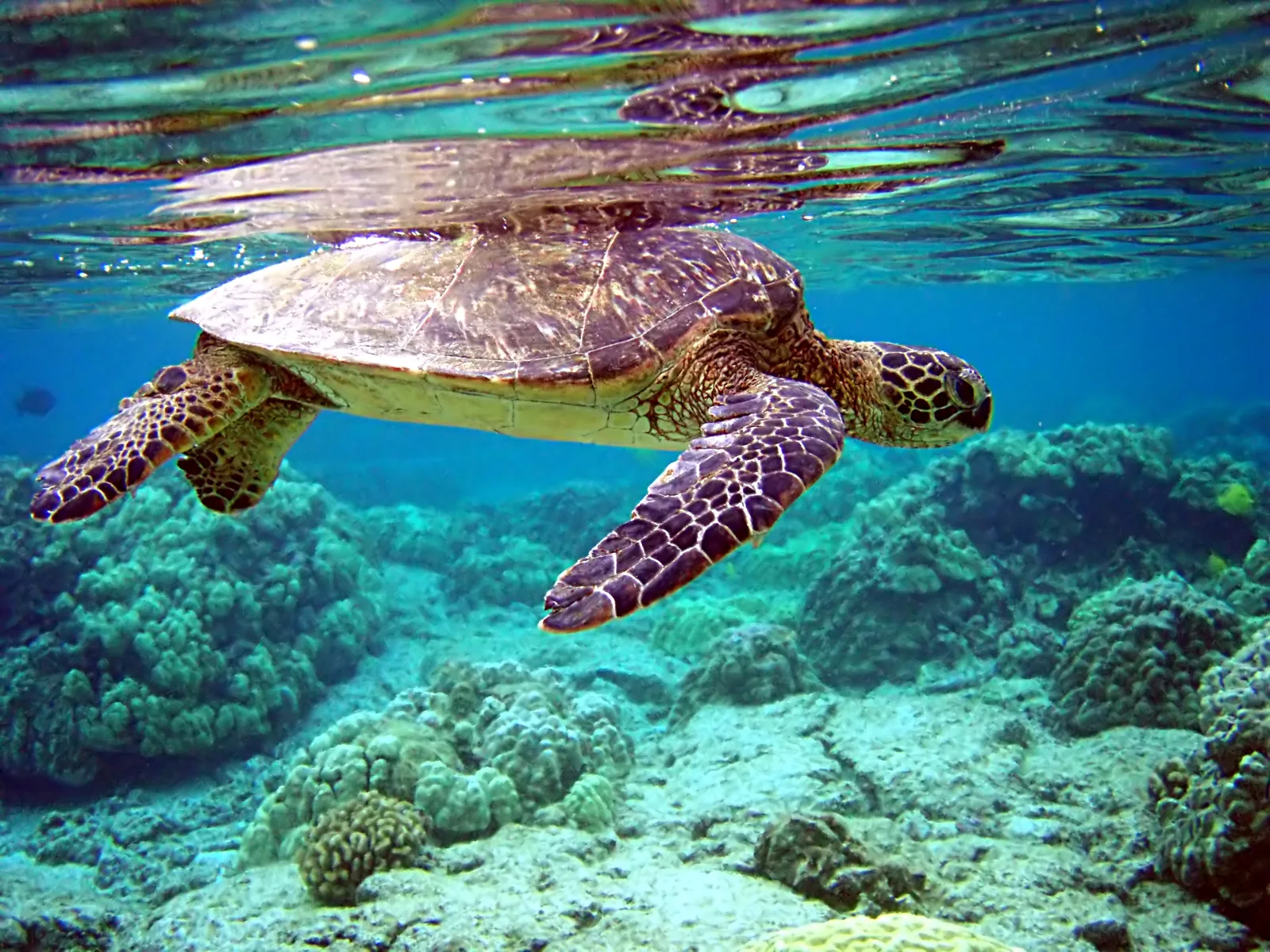
Green Sea Turtle
Chelonia mydas
How to compare two organisms
Choose two species and trace their closest shared group. Then compare a trait with the same definition on each side. Check the units, life stage and context before interpreting a measurement or range.
Missing data means that the collection lacks a sourced value. Where a characteristic does not apply to a lineage, the comparison labels it separately. Open the two profiles for context and follow their sources before drawing a conclusion.
Biological comparison
Means, ranges and reported maxima describe different things. Check the source and population before comparing values.
Classification
Shared ancestry
Closest shared evolutionary group · Bilateria.
Separate lineages
| Characteristic | Day Octopus | Green Sea Turtle |
|---|---|---|
Scientific measurements | Scientific measurements | |
| Body mass |
0.400–6.400 kg
Reported range · Male · Mature (field stage III) · Southwest Madagascar · Artisanal catch sample Source and measurement contextSmallest and largest stage III adults classified in artisanal catches from shallow reefs. · ≈ 0.882–14.11 lb Mass of an individual animal.
0.450–5.500 kg
Reported range · Female · Mature (field stage III) · Southwest Madagascar · Artisanal catch sample Source and measurement contextSmallest and largest stage III adults classified in artisanal catches from shallow reefs. · ≈ 0.992–12.13 lb Mass of an individual animal.
|
104.3–176.8 kg
Reported range · Female · Nesting adults · East Florida Source and measurement contextObserved range in 15 nesting females. The study reports a mean of 136.1 kg (SD 17.7 kg). · ≈ 229.9–389.8 lb Mass of an individual animal.
|
| Straight carapace length | Different measurement scope |
83.2–116.7 cm
Reported range · Female · Nesting adults · East Florida Source and measurement contextObserved range in 90 adult nesting females from two east Florida beach study areas. The study reports a mean of 101.5 cm (SD 5.83 cm). · ≈ 32.8–45.94 in Straight-line length of the carapace between the landmarks used by the reporting survey.
|
Context-specific measurements | Context-specific measurements | |
| Mass at settlement |
0.33 g
Approximate value · Newly settled juveniles · Hawaiʻi · Context-specific record Source and measurement contextThe NOAA account gives an approximate at-settlement value based on Wells and Wells (1970), who studied newly settled Day Octopuses from Hawaiʻi. Mass of a young animal during the transition from the plankton to life on the seabed.
| Different measurement scope |
| Straight carapace length | Different measurement scope |
42.7 cm
Mean · Mixed life stages · Southeast U.S. Atlantic · Stranding records · Context-specific record Source and measurement contextMean for 1,036 strandings with straight carapace lengths recorded along the Southeast U.S. Atlantic in 1985–1991. · ≈ 16.8 in Straight-line length of the carapace between the landmarks used by the reporting survey.
|
Natural history | Natural history | |
| Nutrition and energy acquisition |
Crustaceans, molluscs and fish are among its prey. Flexible arms explore places that a rigid-bodied predator cannot easily reach. Source 1 ↗ |
Many adults are primarily herbivorous. Juveniles may also eat animal material, so diet changes with life stage and locality. Source 1 ↗Source 2 ↗Source 3 ↗Source 4 ↗ |
| Habitat |
Coral and rocky reefs offer crevices for shelter and varied surfaces over which to forage. A den can serve as a retreat between hunting excursions. Source 1 ↗ |
Seagrass beds, algal areas and other coastal habitats support feeding. Females require suitable sandy beaches to nest. Source 1 ↗Source 2 ↗Source 3 ↗Source 4 ↗ |
| Geographic distribution |
Native to tropical Indo-Pacific waters. Its reef habitat includes both exposed surfaces and protected holes. Source 1 ↗ |
The species occurs in tropical and subtropical oceans. Nesting and feeding populations should be interpreted regionally. Source 1 ↗Source 2 ↗Source 3 ↗Source 4 ↗ |
| Morphology |
Eight flexible, sucker-bearing arms surround the mouth. Rapid changes in skin color and texture help the animal blend with complex reef surfaces. Source 1 ↗ |
A streamlined shell, paddle-like forelimbs and a relatively small head suit marine life. The common name refers to body fat rather than a uniformly green shell. Source 1 ↗Source 2 ↗Source 3 ↗Source 4 ↗ |
| Reproduction and life cycle |
The female guards and tends her eggs. Brood care involves reduced or absent feeding, and reproduction is followed by the end of the adult female’s life. Source 1 ↗ |
Females bury eggs in beach nests. Hatchlings enter the sea and pass through juvenile habitats before adulthood. Source 1 ↗Source 2 ↗Source 3 ↗Source 4 ↗ |
| Ecological role |
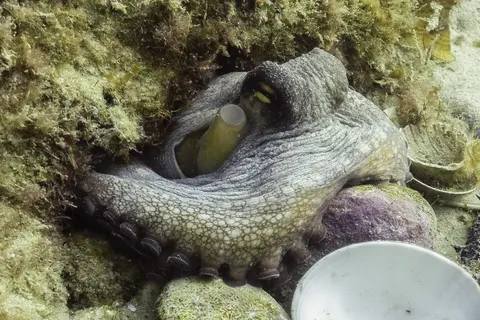
A day octopus may take its catch back to a den. Shells left near the entrance form a midden and …A day octopus may take its catch back to a den. Shells left near the entrance form a midden and can show what it has eaten. NOAA records the species searching coral heads and reef crevices for crabs and mollusks. A midden samples prey carried to that den, so it gives an incomplete picture of the octopus's diet. |
Grazing influences seagrass and algal communities, and movements redistribute nutrients. Source 1 ↗Source 2 ↗Source 3 ↗Source 4 ↗ |
| Behavior and activity |
Individuals are generally solitary. Crawling and camouflage support hunting; an ink release can help an octopus escape a threat. Source 1 ↗ |
Turtles migrate between feeding and breeding areas and return to the surface to breathe. Source 1 ↗Source 2 ↗Source 3 ↗Source 4 ↗ |
| Environmental adaptations |
A soft body, grasping suckers and adjustable skin appearance make it an effective hunter in a structurally complex environment. Source 1 ↗ |
Efficient swimming and orientation support travel between distant habitats. Source 1 ↗Source 2 ↗Source 3 ↗Source 4 ↗ |
| Conservation |
No separate account recorded |
The global IUCN assessment published in 2025 lists the green turtle as Least Concern. This global improvement does not remove …The global IUCN assessment published in 2025 lists the green turtle as Least Concern. This global improvement does not remove regional threats from bycatch, coastal development or habitat loss, and it is distinct from national protection categories. |
Sources from both profiles
Day Octopus
More comparisons
Framed for display
