 Living Beings
NOAA records this octopus foraging around coral heads and rocky crevices on shallow tropical reefs. Source ↗
Published literatureRelationship Network
Explore how an organism connects to its relatives, food, and habitat. Select a connection to read the observation and its source.
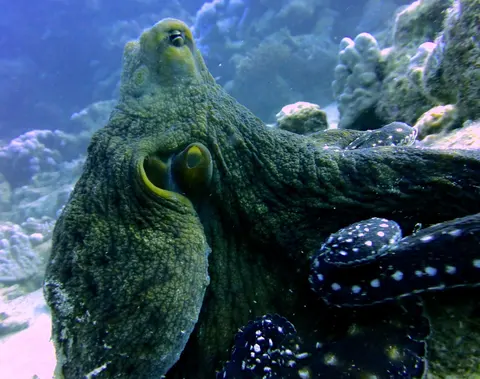
Day OctopusOctopus cyanea
5 displayed connections
Choose a different organism
Find an organism or filter connections
← Return to Ignicoccus hospitalis
Trace a path & display options
Paths follow arrow direction; symmetric relationships can be traversed both ways. Only recorded, reviewed connections are searched.
Drag to orbit or select a node to inspect it. Squares mark habitats. Arrows follow the recorded direction. Positions are schematic.
Crabs are among the prey that NOAA documents during reef foraging. The account does not establish individual crab species. Source ↗
Published literatureBoth profiles belong to the genus Octopus. Source ↗
ClassificationPrincipal classification in the Living Beings taxonomy. Source ↗
ClassificationPrincipal classification in the Living Beings taxonomy. Source ↗
Classification5 connections shown
Another way to explore
Relatives in the collection
These organisms share a recorded family. Classification does not establish an ecological interaction.
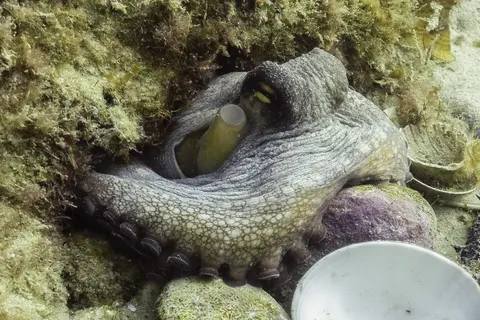 Framed for display
Species · Octopus
Common Octopus
Octopus vulgaris
Eight flexible arms, a soft body and rapidly changing skin make the common octopus an effective coastal predator. The name once covered …